Showing posts with label twitter. Show all posts
    Showing posts with label twitter. Show all posts

    Thursday, February 17, 2011

    Free Webinar 2/22: Common Social Media Mistakes & How To Avoid Them

    Quick heads up on a webinar I'm giving on Feb 22 @ 1:00 Eastern:

    Common Social Media Mistakes, Misconceptions & Missed Opportunites:

    This one-hour (including Q&A session) webinar will examine 5 mistakes, 5 misconceptions & 5 missed opportunities for nonprofits' work with social media AND how to turn these around into positive aspects of your social strategy. Not only would I welcome your attendance, I encourage feedback, questions, etc. - If you have any best practice with your institution you would like included in the highlights or follow-up material, let me know. There's quite a bit in the presentation already, but I'm always happy to add more as appropriate.

    For more visit: http://martsandlundy.com/webinar.php

    Thursday, February 3, 2011

    Kenneth Cole Illustrates How Not To Use Social Media


    Wow. Using a tragedy or conflict like what we're seeing in Egypt is no way to promote one's company. This is exactly how not to use Twitter or any other social platform. While Kenneth Cole has tweeted an apology, I'm quite surprised that this was posted in the first place. Kenneth Cole has also posted this apology on Facebook (screenshot below). Make note of the consumer feedback.


    This clearly doesn't have to do directly with fundraising, but it should be a reminder for nonprofits to be sensitive in all communications - particularly social media where controversy can spread like wildfire.

    Shout-out: Thanks to Lisa Byrne (@lisabyrne) for bringing this to my attention.

    Monday, January 10, 2011

    Campaign highlight: UNICEF Haiti365


    I received a nice email from the MLS Works campaign promoting the UNICEF Haiti365 campaign. Well conceived, basic campaign - good art, good message. Worth sharing. Check out the video aspect of their homepage.

    The email:


    On the web:


    Share your own video and be the voice:


    Twitter, @unicefusa:


    Saturday, January 8, 2011

    Be Our Guest: Epic Change's Stacey Monk


    Please welcome our latest Be Our Guest participant - Stacey Monk (LinkedIn). Stacey is the CEO & Founder of Epic Change, which began in 2008. Her previous work includes owning a boutique consulting firm in San Francisco, working in IT strategy at Genentech, working in welfare reform for Santa Clara County, California, consulting for Deloitte and as an arts administrator at a university theatre in Texas. Stacey has her B.A. in philosophy from Catholic University in D.C. and her M.A. in performing arts management from Carnegie Mellon University's Heinz School of Public Policy & Management. Stacey's work with Epic Change has been recognized as one of the best social media fundraising efforts. Their projects have included Tweetsgiving, To Mama With Love & Epic Thanks. I am honored to have her take part in the blog - Many thanks Stacey!


    What is the biggest challenge your fundraising efforts currently face?
    Creating a sustainable, predictable, stable income source. We also have not had any focus at all on grant writing, so we could probably stand to develop a strategy in that regard.

    What are you doing to overcome these challenges?
    It's one of our top priorities for 2011. We plan to involve our community and design engaging opportunities to transform one-time donors into regular supporters.
    What is the most successful change/program implementation you have made in your current role?
    Our investments in Tanzania have been very successful, having built one of the top-performing primary schools in Arusha (the picture above is Stacey with students in Arusha). From a fundraising standpoint, I think our To Mama With Love project was particularly successful. (See blog post on To Mama here)

    Where do you see social media's best application for fundraising?
    It's constantly evolving. I don't think there are great applications for fundraising, per se. Many tools are great for building communities that eventually generate funds for your cause. Tools and platforms that ask people to invest more than money - to invest their hearts (in the form of personal content, stories & emotion) - will, in my opinion, ultimately have the greatest impact.

    What book/blog/twitter feed would you suggest fundraisers pay attention to in order to further develop their skills?

    What question would you find most useful for the readers to answer?
    We've primarily been successfully funded through grassroots contributions. What ideas do you have to transform one-time contributors into regular supports? If I get two questions (you do, Stacey!), I'd also ask what the best tools are out there for grant research - where's the best place to start? (Stacey - check out @PamelaGrow)


    Monday, January 3, 2011

    Sam Adams, Whole Foods & Your Donors


    I was really struck by a recent post by the awesome Jeff Espositto (web / Twitter / YouTube). In the post, Jeff describes an experience he had searching for a rare Sam Adams brew and how his network, Twitter and Whole Foods came together to save him from going without the new brew. Aside from my love for quality craft brews, I found Jeff's takeaways from the experience worth sharing Through Nonprofit Eyes:

    From Jeff's post:
    A few weeks ago, I attended the Sam Adams unveiling of their new beer Infinium and ever since have been looking to get my hands on a bottle or two. After striking out a few times at my favorite stores, I shot out a tweet asking if anyone had any insight into stores with the elusive beer in stock. Soon after I received this Tweet from someone who I have never met, but am grateful for:
    Shortly after, Jeff received the following from @WholeFoodsRVR:


    Talk about listening and taking care of your customers! As Jeff went on to say, he normally wouldn't have shopped at Whole Foods, but did so because of their quick response. They literally gained a customer through being responsive on Twitter. Here are Jeff's takeaways, with my input for a nonprofit perspective:
    • Grow big ears - I can't count the number of times a potential or former donor has been confused or misinformed about something at a nonprofit and, therefore, has decided not to make a contribution in the future. Every time you see the opportunity to correct misconceptions about your nonprofit, you have the chance to sway someone to "your side" and remove one barrier to giving.
    • Treat every referral as a potential sale, even if it doesn't look like a large win - This one goes out to all the major gift officers. Some of you are great at this, some of you are terrible at it. In many organizations if the annual giving moves a donor through various gift levels, the donor "qualifies" as a major gift prospect and is shuffled on to a gift officer's portfolio. So on one day the prospect is at the top of the annual giving prospect list. The next day, the prospect is at the bottom of a major gift prospect list. If you're the gift officer and cannot take this relationship to the next level - say so!!! It's okay if you have too many bigger donors/prospects to work with, but it's not okay to ignore this group and let them slip into "midrange donor purgatory."
    • Go above and beyond - This always goes a long way with donors, particularly if they feel like they are "only" a small contributor. Think of a time a restaurant treated you better than you ever would have anticipated... Have you gone back? I'm guessing you have. Donors can act the same way.
    • Have fun with the customer - If the situation permits fun and it won't hurt your organization, don't hesitate to illustrate to donors & prospects that you are human! Novel concept, I know, but for large nonprofits in particular, prospects can feel like there's no such thing as a real human. Humor can help when it fits.
    • Small niceties can turn a happy customer into an advocate - Without a doubt, this is true. When people complain to your nonprofit, it is likely because they actually care about the work you're doing. Otherwise, they probably would not take the time to complain. Therefore, being kind & owning any problems or mistakes can turn that negative passion into a positive, advocating voice for your organization.
    • Keep hustling - Always. It helps to be passionate about what you do. If you find you're losing steam or not hustling, take time to reflect and figure out what's keeping you from doing so.
    Thanks to Jeff for giving me the okay to piggy-back on his original post. The tweet images are from his post and the Infinium picture is from DigBoston.

    Thursday, December 2, 2010

    Reason #4,282 Not to Use Twitter/Facebook as Your Only Source


    Some of you know I'm a big soccer (a.k.a. "proper football") fan. Well, today brought disappointing news that the United States' bid to host the 2022 World Cup came in second place to Qatar's bid. Not a huge surprise, considering what a corrupt and political organization soccer's international governing body, FIFA, is, but I digress...

    Given how popular the sport and the World Cup are, it shouldn't come as a surprise that the Twitter trends reflected the awarding of the 2018 games to Russia and 2022 event to Qatar. What might come as a surprise? Well... check out the worldwide trends following the announcement:


    Qatar is nowhere to be seen... but "Quatar" and "Katar" both make the list. While spelling is not the most important thing in the world (I'm sure there are typos on this blog somewhere, so I'm just covering myself), the fact that these two misspellings made worldwide trends should tell you something about how much thought, research and expertise go into many-a-tweet. Or, more accurately, doesn't go into tweets or Facebook postings. Some will simply pass on information from others as fact, without stopping to consider how accurate the info may be.

    Just another example and reason to be careful about using Twitter or Facebook as your sole source for any information.


    Tuesday, November 23, 2010

    Best Practice: Thanksgiving Campaign @EpicChange

    The @EpicChange campaign is well documented and often cited as an early example of putting Twitter to use for social change. If you've heard the term "Tweetsgiving" you have @EpicChange to thank.

    Here is how they describe themselves online:
    ----------------------------------------------------------
    Epic Thanks is a global celebration that seeks to change the world through the power of gratitude. Founded in 2008, the original TweetsGiving celebration was imagined and implemented by six volunteers in six days, and quickly became the #1 trending topic on Twitter as thousands of grateful tweets from across the globe filled the stream.

    But the truth is TweetsGiving was never about twitter or social media. It's about the gratitude in our hearts, and the transformative power our thankfulness can have when we share it with one another. It's about cultivating a deep sense of for those remarkable souls who create hope in our world. That's why this year, TweetsGiving becomes Epic Thanks.

    Over the past two years, from the gratitude of thousands, this global event has built two classrooms and a library in Arusha, Tanzania, where the twitterkids, led by local changemaker Mama Lucy Kamptoni, learn and grow at one of the best primary schools in their country.

    This year, the celebration will spread to honor even more changemakers in other parts of the world. Stay tuned here to be the first to find out whose hopeful dreams we'll invest in this year.
    ----------------------------------------------------------
    This year's campaign looks great and will hopefully celebrate similar success over the next few days. Here's a look at the campaign:

    Campaign email:
    It's engaging, acknowledges that I have participated in the past and immediately encourages me to get involved again. The only negative? For some reason, the one image doesn't load in any of the browsers I tried.


    The website:
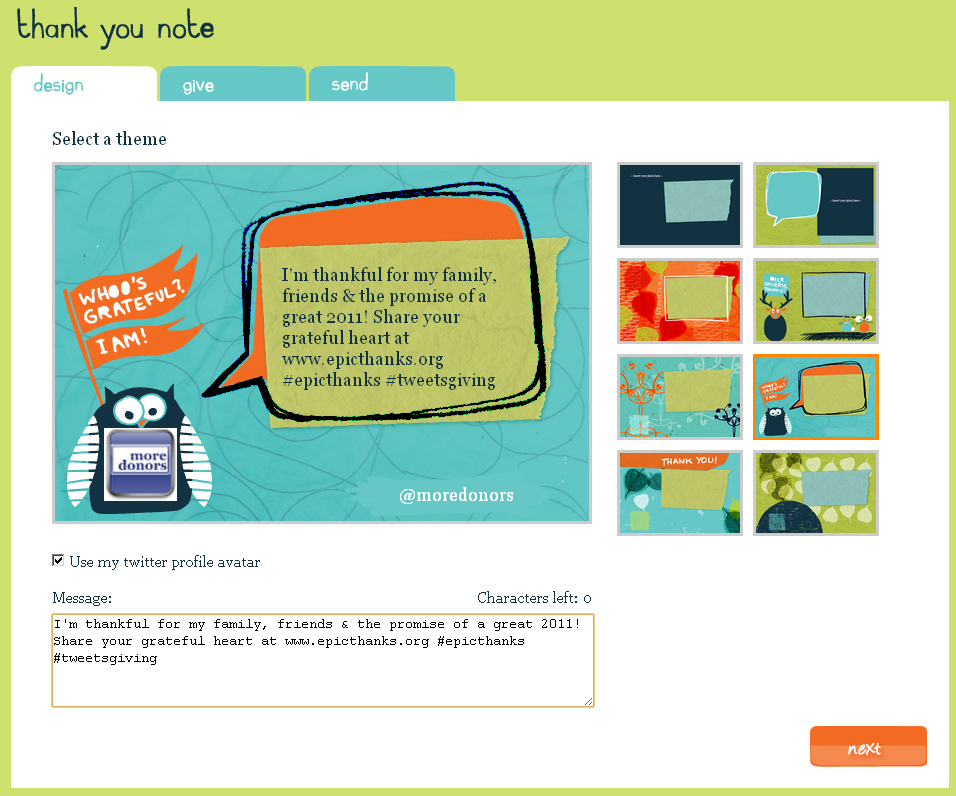
    You can post to Twitter or Facebook and immediately show gratitude and promote the campaign. You can also personalize your own thank you card (see below).


    Facebook:

    Thank you note generator:


    Monday, November 1, 2010

    The Nonprofit Ferris Bueller Experience


    So about six months ago there was a buzz created on Twitter & Foursquare when someone setup fake accounts for Ferris Bueller and some of the other characters from the classic Ferris Bueller's Day Off. The exciting part about this "event" was that the person behind the accounts paid special attention to live out the day on Twitter as if Ferris & Co. were tweeting the day away during the movie. Tech Crunch (@TechCrunch) provides a good summary of the event.

    Ever since, I've had an email from my sister with the TechCrunch link in my inbox, trying to think about how this fun form of engagement could be used to benefit a nonprofit. I finally have a few ideas to share:
    • If you're in the arts sector, have key members of your performance (conductor, musicians, actors & actresses, lighting director, etc.) tweet throughout the performance. On top of this, encourage attendees to - GASP! - tweet during the show! At the end of the performance, post some of your favorites from the audience on a screen and giveaway a few prizes for fun.
    • In education? Have characters tweet throughout the first day of classes, the start of finals week, spring break, graduation, etc. - In a similar fashion to the art example, you can post favorites at various events. You can also promote these feeds to parents & families to engage them in what their sons & daughters may be experiencing.
    • And then there's my idea for any nonprofit, provided the resources are in place to support this communications effort - Have your CEO/President "take the day off" and parallel Ferris Bueller's adventures... just enough of a parallel to be recognizable as a play on the movie, but working in tidbits about what is great about the organization. A food bank CEO might get Abe Froman (sausage king of Chicago) to donate food to the food bank. A youth group executive may be excited about heading to a Cubs game, only to lament not being able to take some of the kids from the group.


    What are your ideas?

    Bueller?

    Bueller?

    Post your ideas in the comments section below.

    Friday, October 29, 2010

    Follow: @BeTheMatch


    This week I met a woman who is organizing a bone marrow drive to help her business partner's mother fight leukemia. I offered to help with the fundraising and donor recruitment... so this week's #FollowOfTheWeek is also a part of my research for that drive: @BeTheMatch

    --------------------------------------------------------------------

    Twitter: @BeTheMatch
    Name: National Marrow Donor Program
    Web: www.BeTheMatch.org
    Bio: Be The Match helps save lives. Thousands with life-threatening diseases like leukemia or sickle cell depend on BeTheMatch Registry to find a bone marrow donor.
    Followers: 3,022 + you!
    Why Follow? Bone marrow donation is a life-saving activity. However, there are still many challenges to finding enough participants. Follow @BeTheMatch to see some great recruitment and engagement of constituents.

    @BeTheMatch is also on: Web / Facebook / Blog / LinkedIn / Flickr
    --------------------------------------------------------------------

    Some screenshots and examples follow - enjoy!

    Twitter page:


    Great Facebook page for involvement:


    Home page:


    An outstanding page for taking action. The only problem? It's not prominent on the front page. For example, social media icons & links to BeTheMatch on Facebook and Twitter are not evident when you first visit the page.


    A YouTube video via Shaq:


    Thursday, October 21, 2010

    Example: Focused Campaign Within a Large Nonprofit


    The attitude of leadership at large nonprofits toward mini "boutique" campaigns can often be described by one of the most famous cinematic lines of all time: Frankly my dear, I don't give a damn.

    Of course, rather than dear you would need to insert AVP, Director of Annual Giving, or some other title.

    A few of my recent conversations have discussed how large nonprofit organizations could benefit from focused boutique campaigns with relatively small goals. Not surprisingly, these conversations have often been as a result of the question How can [Example University] use social media to raise money? My viewpoint is that large organizations can target small segments of their data with unique, specific, urgent campaigns and have great success. Yes, social media can be the primary component. No, it shouldn't be the only component. Things like press releases and mini-events can gain your campaign the attention that can make such a campaign successful.

    The push-back associated with campaigns like these is often a resistance to dedicating resources to a campaign that is only $20,000 or something similar. That leads to how I think large organizations could succeed at raising enough money to make the dedication of resources worthwhile: developing a systematic approach and campaign calendar that provides your organization the ability to have dozens of these boutique campaigns per year. This way, your totals will start to turn into "real money" and you will not have to reinvent the wheel with each campaign.

    So on the heels of one of these such conversations, I met with my friend and colleague at the University of Texas-Austin, Carolyn Connerat. She is the Executive Director of Development and Campaign Manager for the Campaign for Texas. We were discussing the opportunity for boutique campaigns to be successful at large institutions when she shared the Harry Ransom Center's campaign to save the Gone With The Wind costumes. It was a great success, gained international attention, and only had a goal of $30,000. I have included some images below to illustrate how such a campaign could be successful for other large organizations.

    I realize that not ever organization or institution has Scarlett O'Hara's costume to gain attention, but I'm willing to bet you can uncover some creative, fun "small" campaigns that would draw attention.

    Have you already had such a boutique campaign? Please share any similar stories in the comments section.

    By the way... I know there's a pun somewhere between "boutique" campaign and "Gone With The Wind costumes," I'm just not feeling it... plus, I already used the "don't give a damn" line. :)

    Learn more about the campaign & Harry Ransom Center: Web / Twitter / Facebook / YouTube / Flickr

    The campaign website:


    Facebook promotion of NPR story on the campaign:


    Twitter examples:


    A great visual thank you for those that supported the campaign (see the page here):


    Tuesday, October 12, 2010

    Twitter: Quality>Quantity

    I have seen this thread come up many times in my LinkedIn email updates and it finally pushed me over the edge today... so I am posting about auto-pilot Twitter account settings Through Non-Profit Eyes.

    Here is the thread I'm referring to:


    I'll admit, the first time I saw this I thought "Wow, that's sweet!" ... but as I started to look into the tools and better understand what the thread was suggesting, I realized it was the path to an empty list of followers. It should go without saying, but just in case: 100 quality, engaged followers is better than 10,000 disengaged followers. Hence the title of this post: Quality>Quantity.

    So my words of advice to non-profits starting Twitter accounts, blogs, Facebook pages, etc.:

    Focus on building quality relationships,
    rather than aiming for a number of fans or followers.
    If you build it (quality), they (quantity) will come.

    Some tips can be found on these pages:


    Best Practice: Involvement Made Easy by @AlexsLemonade

    Yesterday I shared a great example from @OfficialLove146 about engaging constituents via Twitter - it illustrated the organization's impact.

    Today I share an example from @AlexsLemonade that is a great illustration of how to encourage involvement in your organization. See the tweet and blog post below. I particularly like:
    • The tweet's language invites & encourages new people to get involved by making involvement seem easy;
    • The blog post, though long, gives many different ways to get involved - it's got something for everyone; and,
    • The inclusion of links at the end of each event listing makes it easy to take action immediately.
    Kudos ALSF!

    Note: Each image has a direct link to the tweet/post.


    Monday, October 11, 2010

    Example: Engaging via Twitter

    Noticed a great example of engaging constituents from Love146 this morning:


    Note how in no more than 140 characters, @RobLove146 is:
    • Providing timely news;
    • Illustrating the impact of the organization; and,
    • Suggesting further engagement by providing the link.
    Kudos Love146! This is a great way to engage donors, followers, prospects... and anyone else in their audience. Do you have any examples of similar engagement? Share in the comment section below!

    Friday, October 1, 2010

    USA Today wants me to what?


    There's benefit to using channels such as Twitter and Facebook to promote content across other channels - sharing a Facebook campaign on Twitter, tweeting about a blog posting, etc.

    But when your goal is engagement, I suggest you don't follow @USAToday's
    example above. I'm a fan of USA Today and I appreciate the kind things the publication has said about my blog, but the tweet above is an engagement failure.

    Suppose you are reading that tweet... USA Today is asking you to leave Twitter, send an email, so you can participate in a Facebook chat. Huh? Could I have a few more hoops to jump through please? ;) I don't mind the promotion of the Facebook chat, but why not ask for questions directly on Twitter?

    I would suggest something like:

    #NCAA football fans: Tweet your questions for a Facebook chat Monday at 12 p.m ET. Use the #ncaachat hashtag so @Erick_Smith can respond!

    USA Today does a decent job promoting this on Facebook, as you would expect.


    I hope this is a good reminder for all non-profits to make it as easy as possible for people to engage with your organization.

    Tuesday, September 28, 2010

    Something Is Technically Wrong. Again. And Again.


    This is getting really old, Twitter.

    Monday, September 27, 2010

    Follow: @Cookies4Kids


    So an old summer camp friend of mine - yes, those friendships can last! - emailed me last week about a campaign for @Cookies4Kids. After doing some research, it was evident that C4K should be this week's #FollowOfTheWeek.

    Back story: My friend's husband is Marty Smith (@MartySmithESPN), ESPN's lead NASCAR guy. While I have to admit I don't follow NASCAR closely, I do appreciate their marketing efforts. This cause is close to Marty's heart and tied to NASCAR via a competition between non-profits. @Cookies4Kids is up against others in the Jimmie Johnson Foundation's & Samsung's Helmet of Hope campaign. Enjoy the information below... and GO VOTE!

    Twitter: @Cookies4Kids
    Name: Cookies 4 Kids
    Web: www.cookies4kids.org
    Bio: Cookies for Kids' Cancer raises funds through local bake sales to support research for new and improved therapies for pediatric cancer.
    Followers: 775 + you!
    Why Follow? Clearly this is a worthy cause. But it is also worth following because they do a good job of using social media to promote a cause. Plus - if you read the "Kids Who Inspire Us" page below... you'll be moved to follow!

    @Cookies4Kids is also on: Web / Facebook
    Jimmie Johnson Foundation is also on: Web / YouTube
    --------------------------------------------------------------------

    Some screenshots and examples follow - enjoy!

    Twitter Page:


    Kids Who Inspire Us page:


    Facebook page:


    The competition:


    The other charities in the competition:


    And here's a video from Jimmie Johnson regarding the competition:


    Monday, September 20, 2010

    Follow: @JoinRed


    Did you know Social Good Day is in three days? Well Mashable & (RED) are sponsoring the event to coincide with UN Week and the Social Good Summit. I received the following email and decided that @joinred was perfect as a #FollowOfTheWeek. Not only because it is a good cause... but because they are an example of a non-profit using social media well. It also ties in well with last weeks' #Follow. Enjoy!


    Twitter: @joinred
    Name: The (RED) Campaign
    Web: www.joinred.com
    Bio: Bringing people and brands together to help fight AIDS in Africa. Join us! Follow (RED).
    Followers: 1,027,016 + you!
    Why Follow? Clearly this is a worthy cause. But it is also worth following because they do a good job of using social media to promote a cause.
    Celebrities on board? (Not a reason to follow... just interesting) Bono and many others...

    @JoinRed is also on: Web / Facebook / YouTube

    --------------------------------------------------------------------

    Some screenshots and examples follow - enjoy!

    Web site:


    Facebook pages - Shopping


    Facebook pages - About the campaign


    Facebook pages - The Lazarus Effect (documentary)


    Facebook pages - Main Page


    Twitter page:


    Video (Lazarus Effect):


    The meetups near you: