Showing posts with label best practice. Show all posts
    Showing posts with label best practice. Show all posts

    Thursday, October 6, 2011

    SMS / Mobile giving case study


    (from my original post at Marts & Lundy)

    In a recent discussion at the CASE Social Media & Community conference, the discussion entitled Future Trends in Social Media identified mobile/text/SMS giving was identified as the topic likely to gain the most in attention and importance before next year’s conference. In the course of the discussion, ideas were considered for how this might work within higher education, but actual examples are difficult to find.

    In order to provide a concrete example, I contacted my colleague Howard Heevner at the University of California, Santa Cruz, with whom I have worked on numerous occasions. This past February, while Howard was director of annual giving there, Penn State embarked on its first SMS campaign for its Dance Marathon event. “THON” is the world’s largest student-run philanthropy and raises significant funds to fight pediatric cancer and support those impacted by the disease. The 2011 edition generated over $9.5M in gifts.

    So how did the SMS portion of the fundraising perform? Download the full report in our special reports section.

    Wednesday, October 5, 2011

    1 Month = 6,000 Donors = 17% of Those Solicited. Really?

    (from a post by Kathy Howrigan @ my firm, Marts & Lundy)

    Really. In a recent #fundchat Twitter chat, the topic of multi-channel marketing came up. I mentioned that when I was at Dartmouth College, we did a “challenge” integrating messages from direct mail, phonathon, e-mails, volunteer managers, and anyone else who would talk about it. It was hugely successful, totally exceeding our expectations, so Dan Blakemore asked me to elaborate a little bit — hence my first guest blog post. (We are republishing the blog here in case you missed it at danblakemore.org.)


    Sylvia Racca, Executive Director of the Dartmouth College Fund, and I designed the challenge (but it was her idea). I debated sharing the theme and messaging we used for the challenge in this blog post, but as I worked through it, I realized it would be way too long. Anyone who is interested should feel free to contact me for more information.


    ------------------------------------------


    The goal: The Dartmouth College Fund’s participation goal for fiscal year 2006 was 50 percent. In February, we realized that we were behind the curve to hit 50%, especially in bringing lapsed donors back on board. To reach this milestone, the Fund needed to increase the number of lapsed donors significantly in the months of April, May and June over previous years. To help achieve our goal, we created “The April Challenge.” More specifically, our goal was to get 4,000 alumni to give in the month of April (note that the record at the time for April donors was less than 2,400).

    ------------------------------------------


    The strategy: A “challenge.” Find some leadership donors who would offer to give X dollars per Y donors – no matter the size of the gift.

    ------------------------------------------


    The plan: Four alumni challenged the Dartmouth College Fund to bring in gifts from 4,000 donors in April. At each 1,000 donor benchmark, each donor would give the Fund $25,000 (up to $100,000 each).

    Because we were concerned that the challenge would only cause regular donors to give earlier in the year – in April and not June (which would get us to our challenge goal but not to 50 percent), we wanted to develop a segmentation strategy for lapsed donors. We knew we needed to do well in these categories. We set goals by solicitation strategy (direct mail, phonathon and volunteer solicitation) and by giving segment (last year donors, one year lapsed, two year lapsed, three year lapsed, four year lapsed, five year plus lapsed and never givers), and used these goals to develop the marketing plan. These goals were applied specifically to each channel as well, and closely monitored all month.
    The marketing plan included a direct mail piece sent to 33,424 non-donors, inserts for pledge reminders distributed during April, customized scripts for the student phonathon callers, five e-mail solicitations directing non-donors to our website to make an online gift, and communication with our volunteers. A special webpage, which included a “thermometer” tracking progress towards the challenge goal, was created and promoted through the e-mails, student callers, and on the main webpage.

    ------------------------------------------


    The results: The April Challenge final cash donor count for April 2006 was 6,031 donors. The previous record for the month of April was 2,379 donors.


    • In the end, we did well in all segments, including LYBUNTs, but it was recapturing lapsed donors that pushed us over the top.

    • 1,199 alumni made a gift for the first time in several years and 370 were first-time donors.

    • The student phonathon brought in a total of 2,058 donors, 121 percent of our goal.

    • Volunteer teams and direct mail donors equaled 3,973, 192 percent of our goal.

    • The DCF online giving site saw tremendous activity during the month of April. The number of online gifts increased with each e-mail solicitation sent. The first e-mail solicitation sent on April 4 resulted in 92 gifts in one day, while the last e-mail sent on Friday, April 28 resulted in a total of 555 gifts from Friday – Sunday.

    • Including the challengers, the April Challenge raised more than 3.8 million dollars.

    The Dartmouth College Fund achieved its ultimate goal of 50 percent participation with a final result of 50.8 percent alumni participation. The success of the April Challenge enabled us to reach this milestone.

    ------------------------------------------


    Most surprising finding: I was most surprised by the e-mail responses — keep in mind that we were e-mailing the SAME PEOPLE! So the 260 donors on April 28th were replying to their FIFTH e-mail solicitation.


    ------------------------------------------


    Why I think The April Challenge was successful:


    • It was metric-driven, with desired metrics informing the strategies.

    • Clear and consistent messaging across all channels.

    • The use of all channels – one direct mail piece and two e-mails would not have been enough.

    • We provided feedback via callers, volunteers and in e-mails on a regular basis.

    • There was a clear deadline.


    Notice that I didn’t list the challenge funds as one of the factors that made the challenge successful. While this is obviously critical for any challenge, finding donor/s willing to make a significant gift is not enough. The key is to be thoughtful, strategic, integrated and purposeful in how to use that generous contribution.

    Sunday, July 10, 2011

    How Google+ Save The World!


    Please excuse the sensationalism embedded in the title of this post. However, it is done so with good intention. Since Google+ became the latest and greatest (and shiniest!) new toy in social media, various blog postings and articles are eager to tout what's great about the platform, what's wrong with it and - of course - who is most important and popular on the network. Here's a sampling (though I encourage you to only skim these with an eye toward realizing how over-the-top and knee-jerk these posts may be):
    So what does this mean for your nonprofit? And why is the title of this post just as sensational? Well... the title was to get your attention. Hopefully I still have it. I don't want to mislead you, but rather I want to get your attention and - hopefully - keep you from making the mistake many will make with every new platform: Diving in way too fast.

    What this all means for your nonprofit is... Take a deep breath. Learn about the platform. Listen to those using it. Play around as an individual and learn what works and what doesn't. Don't - don't! - make super quick decisions on how to use it.

    G+ just may be Google's successful foray into social media (finally... remember Wave? Buzz?). But focus your resources on learning before you dive into the deep end. If you need further motivation to slow down on Google+, Google has announced they'll gradually be deleting non-human accounts (nonprofits, businesses, etc.) until they roll out business profiles at a later date. So if you do too much, it may be for nothing.

    To recap - What are the most important things to do in the meantime?

    1) Listen & Learn

    2) Continue to do well on the other platforms (For example, you should really take a second and like my firm on Facebook) :)

    Thursday, February 17, 2011

    Free Webinar 2/22: Common Social Media Mistakes & How To Avoid Them

    Quick heads up on a webinar I'm giving on Feb 22 @ 1:00 Eastern:

    Common Social Media Mistakes, Misconceptions & Missed Opportunites:

    This one-hour (including Q&A session) webinar will examine 5 mistakes, 5 misconceptions & 5 missed opportunities for nonprofits' work with social media AND how to turn these around into positive aspects of your social strategy. Not only would I welcome your attendance, I encourage feedback, questions, etc. - If you have any best practice with your institution you would like included in the highlights or follow-up material, let me know. There's quite a bit in the presentation already, but I'm always happy to add more as appropriate.

    For more visit: http://martsandlundy.com/webinar.php

    Thursday, February 3, 2011

    Kenneth Cole Illustrates How Not To Use Social Media


    Wow. Using a tragedy or conflict like what we're seeing in Egypt is no way to promote one's company. This is exactly how not to use Twitter or any other social platform. While Kenneth Cole has tweeted an apology, I'm quite surprised that this was posted in the first place. Kenneth Cole has also posted this apology on Facebook (screenshot below). Make note of the consumer feedback.


    This clearly doesn't have to do directly with fundraising, but it should be a reminder for nonprofits to be sensitive in all communications - particularly social media where controversy can spread like wildfire.

    Shout-out: Thanks to Lisa Byrne (@lisabyrne) for bringing this to my attention.

    Sunday, January 16, 2011

    Myths of Social Media Fundraising

    In one of my recent Google alerts, I was directed to an article from Greenleaf Project Management titled Using Social Media For Fundraising. As a social media learn-aholic and fundraising professional, I was drawn to the posting. That was the end of the positive experience... Unfortunately, the post illustrated what many social media fundraising 'newbies' and more than a few nonprofit executives think about the channel. Consider this post a bit of a rebuttal.

    Per the post:

    ----------------------------------------------

    "Most businesses and organizations aren’t ready to commit to quite (the extent Ben & Jerry's did by only advertising via social media), but make no mistake, you should not be without a presence on these powerful (social media) sites. Why?

    #1: It’s free. Free advertising and promotion! Never, ever turn down free advertising.

    #2: The reach is huge: Facebook alone has more than 500 million users, 50% of whom are “active users” who log on every day. Twitter signs up about 300,000 new users every day, according to an article in the Huffington Post.

    #3: The number of people who may see your marketing is limitless (“viral marketing”).

    #4: Allows your organization to benefit from person-to-person fundraising.

    #5: It’s fast and requires little monitoring."

    ----------------------------------------------

    Let's break these down, one-by-one.

    #1: It's free.

    No. It's not. If you are going to do social media management and fundraising properly and have any success, it's going to take time & money. This commitment of resources also represents the opportunity cost of not dedicating the resources to other priorities, like face-to-case fundraising, events, etc.

    Bonus #1a: "Never turn down free advertising." - Basic marketing should tell you that this is not always the case. Free advertising may not be in a location/channel that aligns with your organization's values. Free advertising must align with the audience you are targeting, your messaging strategy, etc.

    #2: The reach is huge.

    I find this quite misleading. The potential reach is huge... the reach is only as good as your messaging and your network.

    #3: The number of people who may see your marketing is limitless (“viral marketing”).

    Ugh. Anyone who tells you that you can plan viral marketing has never tried to do so. A microscopic percentage of postings go viral and those that do generally aren't things you would want to associate with your nonprofit. Here are two of the most popular viral videos of all time... not exactly nonprofit material:

    Numa Numa:


    Leave Britney Alone!


    #4: Allows your organization to benefit from person-to-person fundraising.

    Sure... to an extent. But there's a lot of legwork required to make this happen - a support network in your organization, a successful communication strategy that makes the case for support, people willing to champion your cause and ask for gifts, software/data integration to manage the volunteer gift program, etc.


    #5: It’s fast and requires little monitoring.


    Social media fundraising is far from "set it and forget it," like the good ol' Showtime Compact Rotisserie & BBQ Oven.

    If you want to raise money with social media, it is going to require a time commitment and monitoring, so as to develop the conversation and listen to your constituents.

    I certainly do not like punching holes in another's blog post, but this one demanded it - there are simply too many myths being perpetuated.


    Monday, January 10, 2011

    Campaign highlight: UNICEF Haiti365


    I received a nice email from the MLS Works campaign promoting the UNICEF Haiti365 campaign. Well conceived, basic campaign - good art, good message. Worth sharing. Check out the video aspect of their homepage.

    The email:


    On the web:


    Share your own video and be the voice:


    Twitter, @unicefusa:


    Saturday, January 8, 2011

    Be Our Guest: Epic Change's Stacey Monk


    Please welcome our latest Be Our Guest participant - Stacey Monk (LinkedIn). Stacey is the CEO & Founder of Epic Change, which began in 2008. Her previous work includes owning a boutique consulting firm in San Francisco, working in IT strategy at Genentech, working in welfare reform for Santa Clara County, California, consulting for Deloitte and as an arts administrator at a university theatre in Texas. Stacey has her B.A. in philosophy from Catholic University in D.C. and her M.A. in performing arts management from Carnegie Mellon University's Heinz School of Public Policy & Management. Stacey's work with Epic Change has been recognized as one of the best social media fundraising efforts. Their projects have included Tweetsgiving, To Mama With Love & Epic Thanks. I am honored to have her take part in the blog - Many thanks Stacey!


    What is the biggest challenge your fundraising efforts currently face?
    Creating a sustainable, predictable, stable income source. We also have not had any focus at all on grant writing, so we could probably stand to develop a strategy in that regard.

    What are you doing to overcome these challenges?
    It's one of our top priorities for 2011. We plan to involve our community and design engaging opportunities to transform one-time donors into regular supporters.
    What is the most successful change/program implementation you have made in your current role?
    Our investments in Tanzania have been very successful, having built one of the top-performing primary schools in Arusha (the picture above is Stacey with students in Arusha). From a fundraising standpoint, I think our To Mama With Love project was particularly successful. (See blog post on To Mama here)

    Where do you see social media's best application for fundraising?
    It's constantly evolving. I don't think there are great applications for fundraising, per se. Many tools are great for building communities that eventually generate funds for your cause. Tools and platforms that ask people to invest more than money - to invest their hearts (in the form of personal content, stories & emotion) - will, in my opinion, ultimately have the greatest impact.

    What book/blog/twitter feed would you suggest fundraisers pay attention to in order to further develop their skills?

    What question would you find most useful for the readers to answer?
    We've primarily been successfully funded through grassroots contributions. What ideas do you have to transform one-time contributors into regular supports? If I get two questions (you do, Stacey!), I'd also ask what the best tools are out there for grant research - where's the best place to start? (Stacey - check out @PamelaGrow)


    Thursday, January 6, 2011

    Are All Charity Websites Bad?

    A recent post at the Chronicle of Philanthropy's page by Saundra Schimmelpfennig has an interesting title - Does Your Charity’s Web Site Keep Donors in the Dark?

    I think the general premise of the title is a good one for nonprofits to be asking, but the content of the article is too general - it assumes that nonprofits are all in need of the same type of site. While I do think there are key components of a good nonprofit website - see the 10 Pages Every Charity Website post - it doesn't mean that these will take the same form for each nonprofit.

    Schimmelpfennig notes that most nonprofit sites "feature success stories with photos of happy people, information on how little money is spent on administration costs, and a 'click here to donate' button. If charities do include any information on standards, lessons learned, or evaluation results, they are generally so well hidden that few potential donors ever stumble across them."

    I'm torn by Schimmelpfennig's comments. On one hand, I understand what I think she is trying to get at - having information that is a notch above the average nonprofit is good for any charity website and that administrative costs are not the end-all-be-all of nonprofit management metrics. I just don't know that the point is illustrated as well as it could be. For instance, one of the most important things I want to see when visiting a nonprofit website is impact. What is this nonprofit doing to meet its goals and improve the world. In many cases, that means photos of happy people. I mean... look how happy I am you're reading this blog:


    Schimmelpfennig also notes that the primary source of information for prospective donors is a nonprofit's website. This is important and accurate information. While I appreciate the author's desire to have more about professional standards and organizational structure on a website, I am confident market research would indicate that these are some of the least important factors in a prospect's giving decision.

    With regards to administrative costs - there is a problem with this metric in the nonprofit arena and Schimmelpfennig is right to point it out. While sites like Charity Navigator often rave about low administrative and fundraising costs, a strategic nonprofit will not strive for costs to be too low. In order to have long-term success, a nonprofit must invest in things like donor acquisition campaigns - which often cost more than $1 to raise a $1 - and database improvements, etc. If your nonprofit's costs are too low, you will have short-term success, but lack long-term sustainability.

    Therefore, guidelines like these from Charity Navigator's Approach To Rating Charities page very misleading to nonprofit management:
    We assess four key indicators to determine how efficiently and responsibly a charity functions day to day.

    1) Program Expenses: Percent of total functional expenses spent on programs and services. (higher is better)
    2) Administrative Expenses: Percent of total functional expenses spent on management and general. (lower is better)
    3) Fundraising expenses: Percent of total functional expenses spent on fundraising. (lower is better)
    4) Fundraising efficiency: Amount a charity spends to raise $1. (lower is better)
    Frankly, all of the statements in bold are inaccurate for the reasons I mention above. Schimmelpfennig notes, "Inadequate information on charity Web sites creates the impression that all that is needed to run a nonprofit program are good intentions, lots of donations, low administrative costs, and a few happy stories." Again, I think illustrating impact and your case for support will help overcome these issues and misconceptions, not pushing nonprofits to have detailed reports online in lieu of... well, pictures of happy people.

    Monday, January 3, 2011

    Sam Adams, Whole Foods & Your Donors


    I was really struck by a recent post by the awesome Jeff Espositto (web / Twitter / YouTube). In the post, Jeff describes an experience he had searching for a rare Sam Adams brew and how his network, Twitter and Whole Foods came together to save him from going without the new brew. Aside from my love for quality craft brews, I found Jeff's takeaways from the experience worth sharing Through Nonprofit Eyes:

    From Jeff's post:
    A few weeks ago, I attended the Sam Adams unveiling of their new beer Infinium and ever since have been looking to get my hands on a bottle or two. After striking out a few times at my favorite stores, I shot out a tweet asking if anyone had any insight into stores with the elusive beer in stock. Soon after I received this Tweet from someone who I have never met, but am grateful for:
    Shortly after, Jeff received the following from @WholeFoodsRVR:


    Talk about listening and taking care of your customers! As Jeff went on to say, he normally wouldn't have shopped at Whole Foods, but did so because of their quick response. They literally gained a customer through being responsive on Twitter. Here are Jeff's takeaways, with my input for a nonprofit perspective:
    • Grow big ears - I can't count the number of times a potential or former donor has been confused or misinformed about something at a nonprofit and, therefore, has decided not to make a contribution in the future. Every time you see the opportunity to correct misconceptions about your nonprofit, you have the chance to sway someone to "your side" and remove one barrier to giving.
    • Treat every referral as a potential sale, even if it doesn't look like a large win - This one goes out to all the major gift officers. Some of you are great at this, some of you are terrible at it. In many organizations if the annual giving moves a donor through various gift levels, the donor "qualifies" as a major gift prospect and is shuffled on to a gift officer's portfolio. So on one day the prospect is at the top of the annual giving prospect list. The next day, the prospect is at the bottom of a major gift prospect list. If you're the gift officer and cannot take this relationship to the next level - say so!!! It's okay if you have too many bigger donors/prospects to work with, but it's not okay to ignore this group and let them slip into "midrange donor purgatory."
    • Go above and beyond - This always goes a long way with donors, particularly if they feel like they are "only" a small contributor. Think of a time a restaurant treated you better than you ever would have anticipated... Have you gone back? I'm guessing you have. Donors can act the same way.
    • Have fun with the customer - If the situation permits fun and it won't hurt your organization, don't hesitate to illustrate to donors & prospects that you are human! Novel concept, I know, but for large nonprofits in particular, prospects can feel like there's no such thing as a real human. Humor can help when it fits.
    • Small niceties can turn a happy customer into an advocate - Without a doubt, this is true. When people complain to your nonprofit, it is likely because they actually care about the work you're doing. Otherwise, they probably would not take the time to complain. Therefore, being kind & owning any problems or mistakes can turn that negative passion into a positive, advocating voice for your organization.
    • Keep hustling - Always. It helps to be passionate about what you do. If you find you're losing steam or not hustling, take time to reflect and figure out what's keeping you from doing so.
    Thanks to Jeff for giving me the okay to piggy-back on his original post. The tweet images are from his post and the Infinium picture is from DigBoston.

    Saturday, January 1, 2011

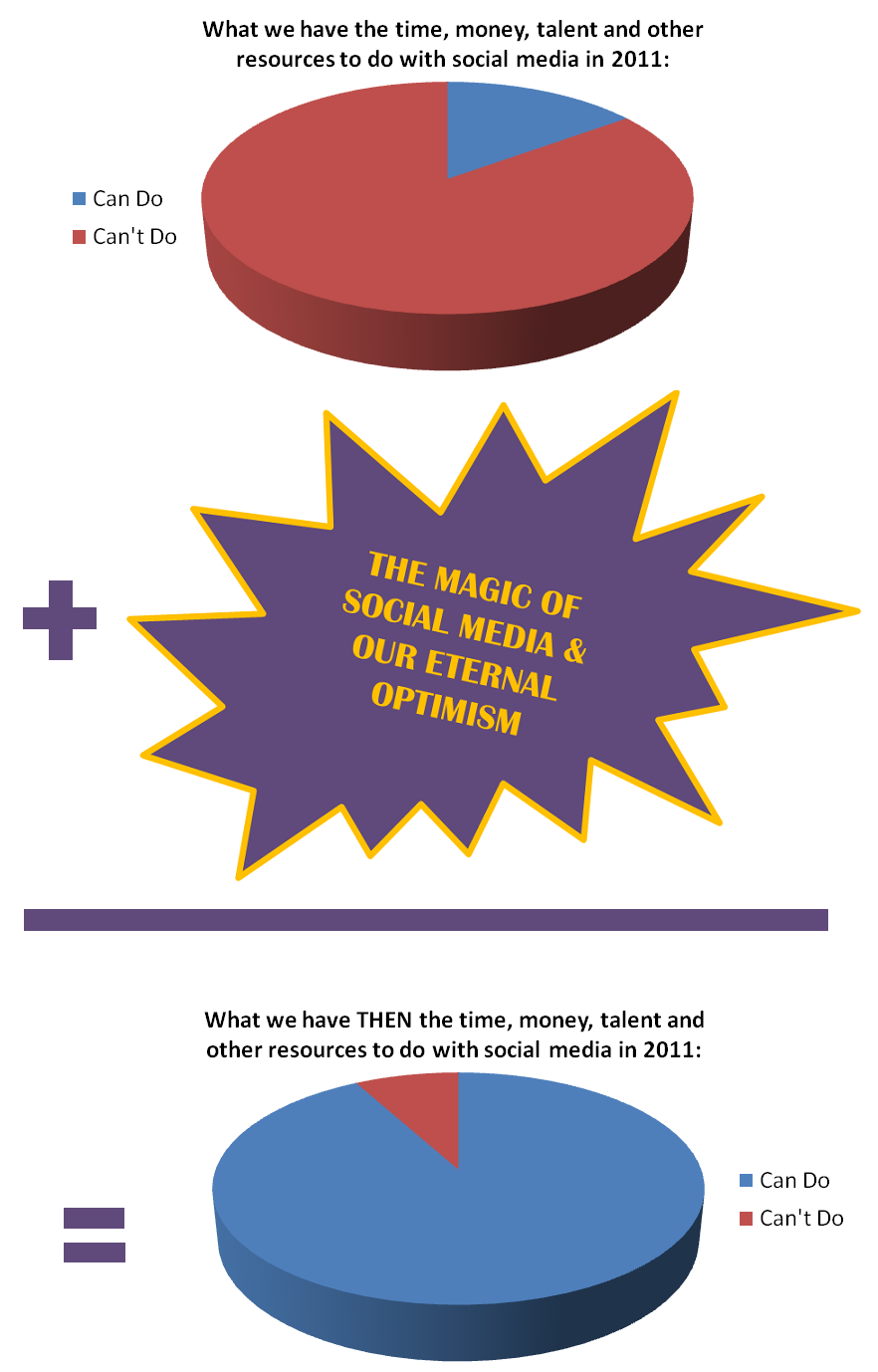
    How Will Your Nonprofit Realistically Use Social Media in 2011?


    Chalk this up as my cynical post. Or an attempted reality check for my readers. Really, I just offer it as a warning for you and your nonprofit's perspective on what social media can do for you in 2011. So I pose this question: How will your nonprofit realistically use social media in 2011? If you could do the time warp to 01/01/12, what are you most certain to have successfully completed?

    Can you do a lot with social media? Definitely. Can you raise a bunch of money with social networking tools? Yep.

    Take those two questions & answers, sprinkle them with a couple descriptions of current social media trends and you have 90% of the nonprofit social media predictions for 2011.

    Here's what isn't always mentioned:

    1) Social media can't do it on its own.

    Social media is a communications channel and can be an important, productive one. However, for the majority of nonprofit organizations it cannot be the only channel used. Phone, mail, events, face-to-face interactions, etc. all play a role in developing the relationships that lead to gifts of time and financial resources. How these channels work together will be one of the most accurate predictors of your success with social media.

    2) A lousy case for support doesn't become great once tweeted. Even if you have someone with "Klout" tweet it.

    There are certain building blocks that need to be present for a prospective donor to make a gift, including a solid case for support. Just because you send a tweet saying...

    "We REALLY need your $ this week - PLS, PLS RT!!!!"

    ...doesn't mean gifts will roll in. Your case for support has to be solid and you have to be able to communicate it well.


    Take a moment to evaluate your case for support and how well you are communicating this case. Bob Groves (@bgroves3), vice president for university advancement at Michigan State University, often refers to basic tasks like this as "blocking & tackling" - the less fancy aspects of football without which a team will fail. Focus on your blocking & tackling and you'll have more success with your fundraising, communications and social media efforts.

    3) Speaking of Klout - it's a lousy metric... don't waste your time on it.

    That's my two cents. I truly cannot think of a way nonprofit organizations could use this where the investment of time in moving the metric would be worth the NPO's time. Don't get caught up in this one. Have a great example of how an NPO could or should use Klout? Please let me know and prove me wrong.

    With all of that said - HAPPY NEW YEAR! There are plenty of great things that can be done in fundraising and while using social media - just remember that it isn't always easy and it certainly isn't always cheap.

    Free webinar w/ @katyan4g & @jocelynharmon


    I don't generally post 'advertisements' (so-to-speak) for webinars, etc., but I know this is a good one, it's cost-friendly (free), and I like the folks putting it on. If you're interested:

    Topic: How Strong Relationships Can Increase Fundraising Results in 2011

    Join Katya Andresen (@katyan4g) from Network for Good and Jocelyn Harmon (@jocelynharmon) from Care2 as they discuss nonprofit online outreach and fundraising in 2011.

    Agenda items:
    • Network For Good study on giving - the findings
    • How to strengthen relationships with your current donors
    • Ways to identify and cultivate new supporters
    • Where (and when) to focus your online activities
    When: Tuesday, January 11th at 1 PM ET

    About The Speakers:

    Katya Andresen is Chief Operating Officer of Network for Good, as well as a speaker, author (Robin Hood Marketing) and blogger about nonprofit marketing, online outreach and the basics of social media. Katya has trained thousands of causes in effective marketing and media relations, and her marketing materials for non-profits have won national and international awards.

    Jocelyn Harmon is Director of Nonprofit Services for Care2.com, where she is responsible for connecting nonprofits to Care2’s 14 million + members so that they can acquire new donors, members and advocacy supporters, online. She is also a recognized blogger and speaker on online marketing for social change. In 2009, Jocelyn was recognized as one of the “Women in Nonprofit Technology Who Rock” by Fast Company. Her personal blog, MarketingforNonprofits.org, is top-ranked on Alltop. She writes a bi-monthly column for Fundraising Success magazine.

    >To register, visit this page.

    Monday, December 20, 2010

    How Driving In A Blizzard Parallels Managing Social Media


    A recent meeting took me to Richmond, Virginia for a couple of days. The journey back was a bit of an adventure... The snow started falling in Richmond around 9:30AM and I started my trek toward the Mason-Dixon line around 1:00PM - enough time for a couple of inches of snow to accumulate.

    As basically anyone I talked to from the Richmond area can attest: 2 inches in central Virginia = Blizzard-like driving conditions. Not so much because the roads are more sensitive to snow in Richmond, Fredericksburg and the surrounding areas, but because the drivers are. Once home I sat pondering the trip and the number of accidents I passed (I stopped counting at 10). I found some parallels in how one tackles a social media plan:

    1) Go Slow, But Not Too Slow: Proceed at a speed that makes you feel safe, but isn't so slow it will cause your fellow drivers (co-workers, marketing staff, etc.) to run into you.

    2) Map Out Your Course: While many of us have become dependent on things like Google Maps and apps to give us turn-by-turn navigation, in a blizzard it is even less safe to be peaking at these while behind the wheel. The lesson? You don't have to memorize your strategy, but you need to know it well enough that you don't have to check it incessantly. This way you will view other campaigns, communications efforts, and opportunities with an eye towards improving your social media efforts. You will be more likely to recognize opportunities for synergy and success.

    3) Be Open To Changing Course: It's not uncommon for you to find your planned path - no matter how much thought you dedicated to it - may not be possible halfway through your journey. Resources may disappear due to budget cuts, Facebook may change the way pages work, Twitter may redesign the way a standard profile appears, etc. Be ready to change on the fly. Two things you can plan in advance are: A) Your attitude when the inevitable road block arises - be positive and confident... it's contagious; and, B) Who you will gather to discuss the issues. If you already know you have a group of X people who will discuss such bumps in the path - and they know they are in the group - you will have an easier time organizing the group and finding a solution quickly.

    4) Don't Stop Just Because You See Others Running Off The Road: Others are going to make mistakes and go slip-sliding-away. Rather than let it deter you from plowing ahead, learn from their mistakes and pay attention to your efforts. (*You have to love me using "plowing" in this analogy, don't you?!?)

    5) Don't Speed Up Just Because You See Others Flying By: Just like others are going to make mistakes, some are going to get lucky and have greater early success than you will. Again, learn from what they have done well and apply it to your campaigns. However, do not skip critical parts of your plan just to "keep up."

    6) Follow A Truck Or Plow: Someone likely has better equipment (technology and tools) or more experience with this kind of driving than you do - follow their leadership and embrace the appropriate tools. Let me know if you need help finding this kind of help or consulting. If I can't help you, I will gladly help pair you with the right person for your needs.

    7) Be Thankful When You Arrive: Don't overlook the short-term success and show gratitude for all involved in your social media efforts.

    8) Be Ready For The Next Blizzard: Keep track of what you did well in your last campaign, hold a debrief meeting afterwards to identify what went wrong, gather it all (wiki?) so that it can help you navigate the drive with more expertise the next time you face a blizzard.

    Please note - If you follow these as actual driving suggestions when in a blizzard you are on your own and I'm not liable for any damage or injuries. ;)


    Tuesday, December 14, 2010

    Free Feedback on Your Nonprofit's Website


    You may recall that the post 10 Pages Every Nonprofit Website Should Have generated a lot of feedback (and it still generates numerous visits to this blog). One result of the post was a LinkedIn group entitled "Nonprofit Website Best Practice." One part of the group is regular nonprofit website review. This provides the members of the group with an opportunity to visit various sites and identify tools, ideas and design elements they may want to implement or avoid on other sites.

    That being said, I invite you to 1) join the group; and, 2) suggest your nonprofit organization's site for the group's review. Submit your site via the comment section below!

    Saturday, December 11, 2010

    What Lies Ahead For Philanthropy?


    I'm putting together a series of super-brief interviews with philanthropic leaders discussing what lies ahead for philanthropy - challenges, opportunities, technological advances, necessary research, social media's place in it all... as well as any other paths that arise from the answers to these questions.

    I have a decent list of names to start with, but I would love your suggestions on who to include. Either email me or post your suggestions in the comments. Thanks!

    Monday, December 6, 2010

    New Book & Contest for Nonprofits


    So the promotion team for a new book by Carol Cone, Jocelyne Daw, Kristian Darigan Merenda and Anne Erhard, Breakthrough Nonprofit Branding, were kind enough to send me a copy of the book to review. Well, I have not yet been able to tackle the book, but a quick skim has me excited. Of course, any book that gets Beth Kanter's (@kanter) endorsement is likely to be worth reading. So why am I posting about it before I can do a full review? Because of this (from the promotional materials):
    ---------------------------------------

    To celebrate the book launch, USA TODAY has donated two national ¼ page ads worth $100,000, which will be awarded to one North American nonprofit organization. In January, the public can vote on the top 10 finalists to decide which will be the lucky winner!

    The deadline to apply is December 10th. UPDATED: Now extended to December 17th.

    ---------------------------------------

    For more information & to enter the contest, please visit this page. For more on the book, go here or to the Twitter account, @BNonprofitBrand. And good luck in the contest!

    Sunday, December 5, 2010

    Planning Ahead: January Holidays Your Nonprofit Can Use


    As many of you know, there is a page on this blog dedicated to holidays nonprofit organizations may be able to use for creative awareness or fundraising campaigns or internal management - such as getting your team behind Universal Letter Writing Week (January 8-14). I'm going to try and do this about a month in advance every month, to give you a little time to plan ahead. If you're interested in planning further ahead or reviewing some of the guidelines on making these holiday campaigns successful for your organization, make sure to visit the original page.

    Here's a quick snapshot of some of January's holidays you may be able to use:

    Bird Day
    Birth Defects Month
    Cervical Cancer Screening Month
    Fun at Work Day
    - Please use this one, it's great for your team!
    Healthy Weight Week
    Humanitarian Day
    Hunt For Happiness Week
    I'm Not Going To Take It Anymore Day
    - Great for asking your constituents to take a stand for your cause.
    Inspire Your Heart with Art Day - Not just for art-focused nonprofits. Use art to illustrate your efforts and impact. Remember, photography, children's art... there are many ways to use this one.
    International Creativity Month - Is there a contest you can have in honor of this month? Asking for creative campaign or solicitation ideas? Campaign themes?
    International Quality of Life Month
    Martin Luther King Day
    National Cut Your Energy Costs Day
    National Glaucoma Awareness Month
    National Lose Weight/Feel Great Week
    National Mentoring Month
    - Another great one to use internally & externally!
    National Poverty in America Awareness Month
    National Volunteer Blood Donor Month
    - If you can, give blood. It's the easiest philanthropic gift you can make (again, if you can).
    New Years Day
    New Year's Resolutions Week
    Thyroid Awareness Month
    Trivia Day
    - Come up with 10 trivia questions about your organization and its efforts - some fun, some illustrating impact and some that are really trivial. Direct folks to the page in honor of Trivia Day (January 4).
    Universal Letter Writing Week - Have everyone on your team write a letter to a handful of random donors to say thanks. Or... ask your donors, volunteers & beneficiaries to write a letter to local media outlets and online to highlight your organization.

    Thursday, December 2, 2010

    Reason #4,282 Not to Use Twitter/Facebook as Your Only Source


    Some of you know I'm a big soccer (a.k.a. "proper football") fan. Well, today brought disappointing news that the United States' bid to host the 2022 World Cup came in second place to Qatar's bid. Not a huge surprise, considering what a corrupt and political organization soccer's international governing body, FIFA, is, but I digress...

    Given how popular the sport and the World Cup are, it shouldn't come as a surprise that the Twitter trends reflected the awarding of the 2018 games to Russia and 2022 event to Qatar. What might come as a surprise? Well... check out the worldwide trends following the announcement:


    Qatar is nowhere to be seen... but "Quatar" and "Katar" both make the list. While spelling is not the most important thing in the world (I'm sure there are typos on this blog somewhere, so I'm just covering myself), the fact that these two misspellings made worldwide trends should tell you something about how much thought, research and expertise go into many-a-tweet. Or, more accurately, doesn't go into tweets or Facebook postings. Some will simply pass on information from others as fact, without stopping to consider how accurate the info may be.

    Just another example and reason to be careful about using Twitter or Facebook as your sole source for any information.


    Wednesday, December 1, 2010

    The Best Nonprofit Fundraising App Ever...


    ...is no app at all. Fundraising apps are pointless - you need to engage and inform if you feel like you must have an app.

    Sorry to pull a bit of a bait-and-switch on you, but I am surprised how many nonprofits are focused on the creation of a fundraising app for their organization.

    This is one of the areas where I believe consumers have different expectations of for-profit and nonprofit organizations. Here are some data eMarketer compiled from mobile app users:


    There are some compelling points for the for-profit organizations to create an engaging mobile app, but let's look at it Through Nonprofit Eyes:

    What would a potential donor gain from your mobile app if it is only for fundraising?
    1) A way to give? Sounds great... but do you have a lot of folks telling you "I was going to give, but there wasn't an app for that?" I may be wrong, but I don't think this is the primary reason folks would install an app, when they could make a gift online via the same phone without jumping through as many hoops;
    2) A way for you to pester them about giving? Hmm...
    3) Anything else?

    I am not claiming there isn't a place for apps in the nonprofit world, but they should be based around the services and expertise provided by the organizations, not strictly making gifts. These type of apps will further inform and engage, which can build a foundation for gifts... but I bet they don't come through an app.

    All of this being said, there are some nonprofits doing a nice job engaging folks with apps. Here you go:


    Great, engaging app with games, events and impact news. Their president, Debbie Bresette, was kind enough to be a guest of the blog in July. This is easily the most-cited example of a good nonprofit app.

    An easy way for NPR supporters and listeners to keep up with NPR programs and news. Just another way for folks to be engaged by NPR and - hopefully - be more likely to give when the ask comes.

    Wednesday, November 24, 2010

    Best Practice: Thanksgiving Email Illustrating Impact

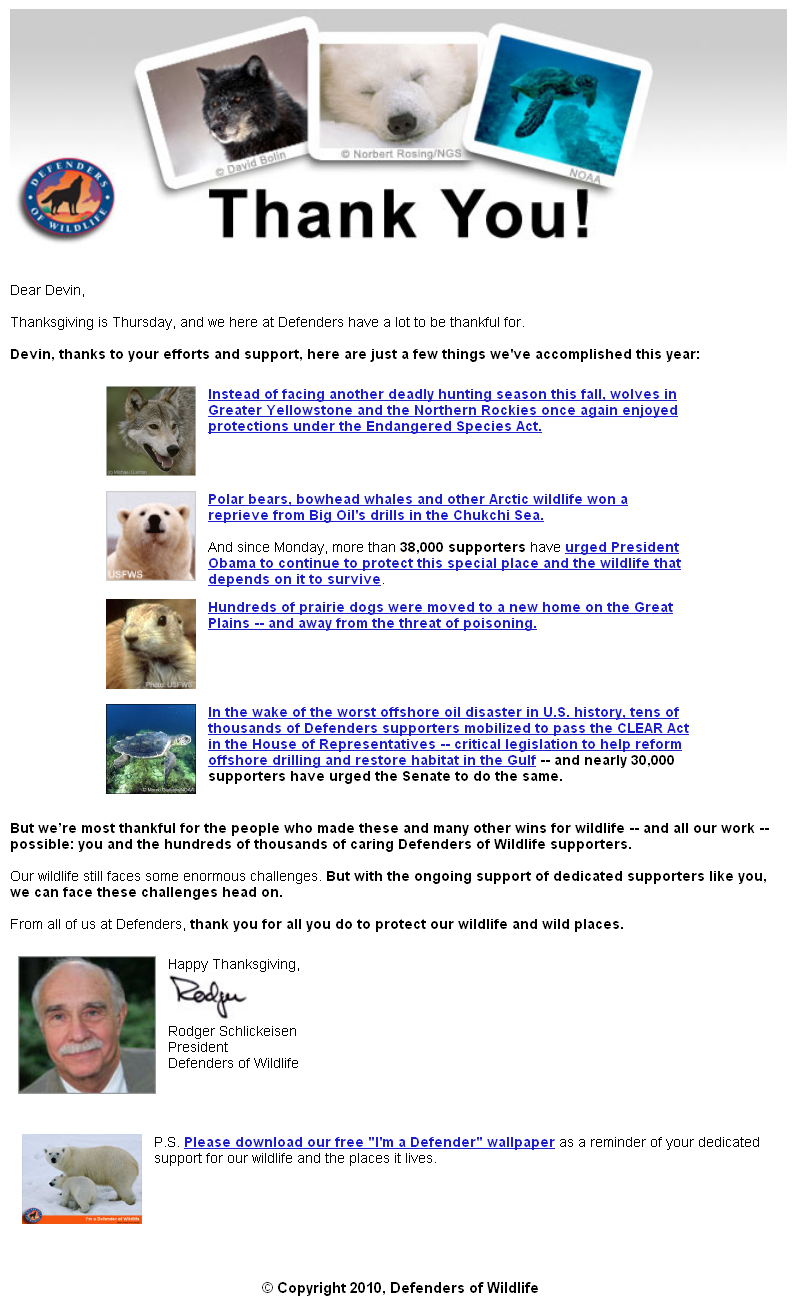
    As you might imagine, I get a number of Thanksgiving messages - email, social media, mail. I thought I would highlight one or two that best caught my attention, with a few insights. The first post was regarding an email I received from Earthjustice. The second post was about the EpicThanks campaign. This third post highlights a great email from Defenders of Wildlife that does an excellent job illustrating the impact the organization and, in turn, its donors had during the past year. Here is the email:


    A few notes on the email:
    • Great focus on impact, including links to five varied stories - at least one of which is likely to appeal to the recipient's passions.
    • The three images at the top make it more likely that the reader will connect with one of those animals, if not all three.
    • I appreciate the image of the organization's president, as it puts a personal face on the message and the organization.
    • The P.S. is a nice 'gift' to the recipient, but also engages the reader on an on-going basis, if they download the free wallpaper. There are actually 33 different wallpapers to choose from. Since I've always been a fan of otters - here's a look at my favorite:


    Kudos Defenders of Wildlife!