Showing posts with label ThroughNonProfitEyes. Show all posts
    Showing posts with label ThroughNonProfitEyes. Show all posts

    Monday, January 3, 2011

    Sam Adams, Whole Foods & Your Donors


    I was really struck by a recent post by the awesome Jeff Espositto (web / Twitter / YouTube). In the post, Jeff describes an experience he had searching for a rare Sam Adams brew and how his network, Twitter and Whole Foods came together to save him from going without the new brew. Aside from my love for quality craft brews, I found Jeff's takeaways from the experience worth sharing Through Nonprofit Eyes:

    From Jeff's post:
    A few weeks ago, I attended the Sam Adams unveiling of their new beer Infinium and ever since have been looking to get my hands on a bottle or two. After striking out a few times at my favorite stores, I shot out a tweet asking if anyone had any insight into stores with the elusive beer in stock. Soon after I received this Tweet from someone who I have never met, but am grateful for:
    Shortly after, Jeff received the following from @WholeFoodsRVR:


    Talk about listening and taking care of your customers! As Jeff went on to say, he normally wouldn't have shopped at Whole Foods, but did so because of their quick response. They literally gained a customer through being responsive on Twitter. Here are Jeff's takeaways, with my input for a nonprofit perspective:
    • Grow big ears - I can't count the number of times a potential or former donor has been confused or misinformed about something at a nonprofit and, therefore, has decided not to make a contribution in the future. Every time you see the opportunity to correct misconceptions about your nonprofit, you have the chance to sway someone to "your side" and remove one barrier to giving.
    • Treat every referral as a potential sale, even if it doesn't look like a large win - This one goes out to all the major gift officers. Some of you are great at this, some of you are terrible at it. In many organizations if the annual giving moves a donor through various gift levels, the donor "qualifies" as a major gift prospect and is shuffled on to a gift officer's portfolio. So on one day the prospect is at the top of the annual giving prospect list. The next day, the prospect is at the bottom of a major gift prospect list. If you're the gift officer and cannot take this relationship to the next level - say so!!! It's okay if you have too many bigger donors/prospects to work with, but it's not okay to ignore this group and let them slip into "midrange donor purgatory."
    • Go above and beyond - This always goes a long way with donors, particularly if they feel like they are "only" a small contributor. Think of a time a restaurant treated you better than you ever would have anticipated... Have you gone back? I'm guessing you have. Donors can act the same way.
    • Have fun with the customer - If the situation permits fun and it won't hurt your organization, don't hesitate to illustrate to donors & prospects that you are human! Novel concept, I know, but for large nonprofits in particular, prospects can feel like there's no such thing as a real human. Humor can help when it fits.
    • Small niceties can turn a happy customer into an advocate - Without a doubt, this is true. When people complain to your nonprofit, it is likely because they actually care about the work you're doing. Otherwise, they probably would not take the time to complain. Therefore, being kind & owning any problems or mistakes can turn that negative passion into a positive, advocating voice for your organization.
    • Keep hustling - Always. It helps to be passionate about what you do. If you find you're losing steam or not hustling, take time to reflect and figure out what's keeping you from doing so.
    Thanks to Jeff for giving me the okay to piggy-back on his original post. The tweet images are from his post and the Infinium picture is from DigBoston.

    Monday, December 20, 2010

    How Driving In A Blizzard Parallels Managing Social Media


    A recent meeting took me to Richmond, Virginia for a couple of days. The journey back was a bit of an adventure... The snow started falling in Richmond around 9:30AM and I started my trek toward the Mason-Dixon line around 1:00PM - enough time for a couple of inches of snow to accumulate.

    As basically anyone I talked to from the Richmond area can attest: 2 inches in central Virginia = Blizzard-like driving conditions. Not so much because the roads are more sensitive to snow in Richmond, Fredericksburg and the surrounding areas, but because the drivers are. Once home I sat pondering the trip and the number of accidents I passed (I stopped counting at 10). I found some parallels in how one tackles a social media plan:

    1) Go Slow, But Not Too Slow: Proceed at a speed that makes you feel safe, but isn't so slow it will cause your fellow drivers (co-workers, marketing staff, etc.) to run into you.

    2) Map Out Your Course: While many of us have become dependent on things like Google Maps and apps to give us turn-by-turn navigation, in a blizzard it is even less safe to be peaking at these while behind the wheel. The lesson? You don't have to memorize your strategy, but you need to know it well enough that you don't have to check it incessantly. This way you will view other campaigns, communications efforts, and opportunities with an eye towards improving your social media efforts. You will be more likely to recognize opportunities for synergy and success.

    3) Be Open To Changing Course: It's not uncommon for you to find your planned path - no matter how much thought you dedicated to it - may not be possible halfway through your journey. Resources may disappear due to budget cuts, Facebook may change the way pages work, Twitter may redesign the way a standard profile appears, etc. Be ready to change on the fly. Two things you can plan in advance are: A) Your attitude when the inevitable road block arises - be positive and confident... it's contagious; and, B) Who you will gather to discuss the issues. If you already know you have a group of X people who will discuss such bumps in the path - and they know they are in the group - you will have an easier time organizing the group and finding a solution quickly.

    4) Don't Stop Just Because You See Others Running Off The Road: Others are going to make mistakes and go slip-sliding-away. Rather than let it deter you from plowing ahead, learn from their mistakes and pay attention to your efforts. (*You have to love me using "plowing" in this analogy, don't you?!?)

    5) Don't Speed Up Just Because You See Others Flying By: Just like others are going to make mistakes, some are going to get lucky and have greater early success than you will. Again, learn from what they have done well and apply it to your campaigns. However, do not skip critical parts of your plan just to "keep up."

    6) Follow A Truck Or Plow: Someone likely has better equipment (technology and tools) or more experience with this kind of driving than you do - follow their leadership and embrace the appropriate tools. Let me know if you need help finding this kind of help or consulting. If I can't help you, I will gladly help pair you with the right person for your needs.

    7) Be Thankful When You Arrive: Don't overlook the short-term success and show gratitude for all involved in your social media efforts.

    8) Be Ready For The Next Blizzard: Keep track of what you did well in your last campaign, hold a debrief meeting afterwards to identify what went wrong, gather it all (wiki?) so that it can help you navigate the drive with more expertise the next time you face a blizzard.

    Please note - If you follow these as actual driving suggestions when in a blizzard you are on your own and I'm not liable for any damage or injuries. ;)


    Wednesday, December 1, 2010

    The Best Nonprofit Fundraising App Ever...


    ...is no app at all. Fundraising apps are pointless - you need to engage and inform if you feel like you must have an app.

    Sorry to pull a bit of a bait-and-switch on you, but I am surprised how many nonprofits are focused on the creation of a fundraising app for their organization.

    This is one of the areas where I believe consumers have different expectations of for-profit and nonprofit organizations. Here are some data eMarketer compiled from mobile app users:


    There are some compelling points for the for-profit organizations to create an engaging mobile app, but let's look at it Through Nonprofit Eyes:

    What would a potential donor gain from your mobile app if it is only for fundraising?
    1) A way to give? Sounds great... but do you have a lot of folks telling you "I was going to give, but there wasn't an app for that?" I may be wrong, but I don't think this is the primary reason folks would install an app, when they could make a gift online via the same phone without jumping through as many hoops;
    2) A way for you to pester them about giving? Hmm...
    3) Anything else?

    I am not claiming there isn't a place for apps in the nonprofit world, but they should be based around the services and expertise provided by the organizations, not strictly making gifts. These type of apps will further inform and engage, which can build a foundation for gifts... but I bet they don't come through an app.

    All of this being said, there are some nonprofits doing a nice job engaging folks with apps. Here you go:


    Great, engaging app with games, events and impact news. Their president, Debbie Bresette, was kind enough to be a guest of the blog in July. This is easily the most-cited example of a good nonprofit app.

    An easy way for NPR supporters and listeners to keep up with NPR programs and news. Just another way for folks to be engaged by NPR and - hopefully - be more likely to give when the ask comes.

    Monday, November 22, 2010

    How The Rules of Dating Apply to Your Donor Relationships, Part II


    It's no secret that there are parallels between wooing a donor and a date. So how well do the rules of dating apply to your donor relationships? Here's a two-part #ThroughNonProfitEyes look at TopDatingTips.com's dating rules. Part I was about the Do's of dating and Part II dives into the Don'ts (a few of which did not have good fundraising parallels and were, therefore, excluded):

    Part II: Dating Rules -- Don'ts

    1. Don't call, text message or email someone you've just started seeing more than once a day unless they reply (or in the event of an emergency).
    Just like a new love interest, a new donor should be treated as if they may disappear for someone better at any second. Smothering a new donor with too many appeals or emails can be a big turn-off, but so can no communication at all. Say thank you, illustrate impact, but don't ask too much too often.

    2. Don't date the kind of people who've hurt you in the past.
    Like in the "Do's" section, where I suggested using data models to find those most likely to support your organization, you can do the same to find those least likely to give. You can then remove them from your appeals, if you need a way to limit your costs.

    3. Don't be late for a date.
    A friend of mine once discussed having made gifts to her and her husband's three combined alma maters on the same day. One sent them a thank you note in less than a week, one in two weeks and one in six weeks. Don't be late with your stewardship efforts.

    4. Don't lie to your date or about any aspect of your life, even if the truth isn't as sexy or you're worried they won't like it.
    This should go without saying, but be honest and transparent in your communications. Imagine a donor giving to an annual fund and thinking that she is supporting student scholarships or food for a soup kitchen and later learning that the funds were actually going to fund a fancy board meeting - not the news your organization would be looking for.

    5. Don't be rude or get drunk on a date.
    If you do make a mistake in your constituent communications, own the error and be polite. Courtesy and manners will get you everywhere - on a date or with donors & prospects.

    6. Don't give out personal information like your home phone number or address on the first date.
    Okay, on this one I am actually going with the opposite - make sure your appeals, communication pieces... everything, has contact information for your organization available for the recipient.

    7. Don't have sex on a first date.
    I have worked with nonprofits that celebrate every gift. It is good & important to appreciate every gift. However, if you steward your $10 donors like they are $10M donors, you are going to create extremely high stewardship expectations or - worse - make the donor question your use of the charitable support. So... don't give everything you have in your stewardship toolbox away to donors right away.

    Sunday, November 21, 2010

    How The Rules of Dating Apply to Your Donor Relationships, Part I


    It's no secret that there are parallels between wooing a donor and a date. So how well do the rules of dating apply to your donor relationships? Here's a two-part #ThroughNonProfitEyes look at TopDatingTips.com's dating rules. Part I is about the Do's of dating and Part II dives into the Don'ts. Part II will be posted later this week.

    Part I: Dating Rules -- Do's

    1. Do try to always look your best and be punctual.
    Don't be sloppy with your appeals and engagement efforts. Make sure you are double- and triple-checking your copy. If you are in a decentralized environment, swallow your pride and do everything you can to break down the silos and coordinate the timing of mailings, emails and other communications. Nothing can turn off a prospect like overlapping, clearly poorly coordinated or timed appeals and messages.

    2. Do try to enjoy yourself on dates.
    For a lot of nonprofit practitioners, the work of soliciting donors and prospects becomes, well... work. This is okay and understandable, but it can often blind us to the positive work our organizations do - and the joy we should feel in helping move our organizations forward.

    3. Do compliment your date on how he or she looks.
    Yep... complimenting your donors can go a long way to renewing them - tell them how great they are and how much it impacted your organization that they gave their time and resources to your organization, before asking for another gift.

    4. Do be interested and interesting.
    From the original Dating rules: "Ask questions, share insights and pay attention when your date is telling you what they like to do, read, watch, listen to, etc." This is virtually dead-on for your donor relationships. You need to ask questions (focus groups & surveys), share insights (keep your prospects & donors informed) and pay attention to what you're being told (respond to requests, apply research findings to your messaging, timing and strategies).

    5. Do tell someone directly if you're not interested in seeing them again.
    Okay... I'm not exactly sure how to parallel this one, to be honest. I would advise you not to tell your non-donors you want nothing to do with them.

    6. Do date only people you're attracted to, no matter what your friends say.
    Low on resources? Use data-modeling to find the prospects most likely to give, a.k.a. most attractive to you.

    7. Do stay positive, even when dates don't end well.
    If prospects ask you to be removed from your lists or appeals... or they simply reject your appeals, take the high road. Respect requests to be removed from lists, follow-up to disgruntled prospects with sincerity, and make sure you have data processes in place to ensure donor requests for communication will be honored.

    8. Do plan ahead.
    Almost any appeal - email, phone, mail, face-to-face, events - will be less successful if you do not plan ahead. And in most cases, your audience will be able to tell your planning was lacking.

    9. Do be proactive about finding people to date.
    Make sure you are putting aside time to reconsider your approach to acquiring new donors. Ask your non-donors why they don't support you. Better yet, ask your previous donors who didn't renew why they failed to do so. Look at various parts of your program and think about unique sources of prospects you haven't considered before. (Ex: University of Texas soliciting Gone With The Wind fans)

    10. Do surround yourself with positive, like-minded people who are dating, too.
    One of the best resources you have available to you are peers across the globe who face similar challenges. Benchmarking and peer-networks can be critical to helping you brainstorm new ideas, escape the creative vacuum of your office, and have a resource to call when faced with a challenge. Don't have any current peer connections? Conferences, community meetings and social networking can help you take the first step. If you aren't sure where to start, let me know and I will do my best to introduce you to a handful of resources.

    Friday, October 29, 2010

    Random Donor & Prospect Thoughts


    Eric Hoover, a senior writer with the Chronicle of Higher Education, shared a post yesterday on the Chronicle's Head Count blog titled Random Student Thoughts on Admissions. It had some interesting tidbits and made me think of the parallels between college admissions and non-profit fundraising efforts... So here's a look at the topic, Through Nonprofit Eyes.

    If your nonprofit has more than one person involved in its operations, you are almost certain to have multiple opinions on what your prospects and donors would like. This can be in terms of appeals, newsletters, events, investments, leadership and a wide variety of other topics. If you have heard phrases like these, you understand what I am referencing:
    • "We need to email our donors more. I hear from XYZ nonprofit all the time and I don't mind."
    • "Our constituents do not like to be asked for money."
    • "Our constituents won't like that mail appeal - I can't stand the way it looks."
    • "I got this [appeal/mailing/email/etc] from ABC nonprofit and loved it - We have to do it too!"
    • "We should only send email and those Twitterer things to our young prospects."
    While people are naturally drawn to designs, appeals, etc. that they like, you are only one person - an "n of 1" in experiment terms - and your opinion may not reflect that of your prospects. No matter how well you think you know them and how much you think they are all like you!

    But in the absence of other information and data, nonprofit administrators will often fill the void with their own opinions. That being said... it is good to remember to listen to your donors and prospects.

    Hoover's post about college admissions included quotes from various students. Here is a sampling - Can you see the potential parallel to nonprofit stakeholders?

    • Dakota Kornicker, a senior at Hunterdon Central Regional High School, in New Jersey, on recruitment emails: “I love getting emails from your college, but I don’t like getting three emails in one day.”
    • Christine Johnson, a senior at Cypress Lakes High School, in Houston, on recruitment mailings: “I find a lot of the stuff I get in the mail from colleges to just get in the way and kind of make me mad … even the short letters from deans saying ‘I’m interested in you’ didn’t really mean anything to me.”
    • Alexander Moskowitz, a senior at Cherry Creek High School, in Colorado, on the value of admissions interviews: “A personal interview shows students that you’re interested in them and that you’re giving them a chance.”
    • Anne Kaplan, a senior at the New York City Lab School for Collaborative Studies, on colleges’ using social-networking sites: “Facebook is the last place I want to see a school.”
    Obviously there are likely to be similar opinions within your constituency. But how do you know? You ask and you listen. I think you'll find many are happy to be engaged. Even those who are unhappy about some aspect of your organization will be happy that the opinion or complaint is actually being heard.

    Do you think Starbucks, Coca-Cola and Toyota are conducting marketing campaigns based simply on what the CEO or Director of Marketing likes?

    Then why should your nonprofit?


    image from ilisten(dot)com

    Tuesday, October 12, 2010

    Twitter: Quality>Quantity

    I have seen this thread come up many times in my LinkedIn email updates and it finally pushed me over the edge today... so I am posting about auto-pilot Twitter account settings Through Non-Profit Eyes.

    Here is the thread I'm referring to:


    I'll admit, the first time I saw this I thought "Wow, that's sweet!" ... but as I started to look into the tools and better understand what the thread was suggesting, I realized it was the path to an empty list of followers. It should go without saying, but just in case: 100 quality, engaged followers is better than 10,000 disengaged followers. Hence the title of this post: Quality>Quantity.

    So my words of advice to non-profits starting Twitter accounts, blogs, Facebook pages, etc.:

    Focus on building quality relationships,
    rather than aiming for a number of fans or followers.
    If you build it (quality), they (quantity) will come.

    Some tips can be found on these pages:


    Saturday, October 2, 2010

    10 Pages Every Charity Website Should Have

    Last week, Barnabas Nagy wrote an article entitled 5 Pages Every Business Website Should Have. It inspired me to take a look at the topic Through Non-Profit Eyes. Therefore, please find 10 Pages Every Charity Website Should Have below, plus some best practice examples via screenshot.

    1) Donation page
    This is first for a reason. One of the main goals of your site is to raise support. Even though other goals may exist as well - sharing your stories, illustrating your good work & impact, recruiting volunteers - the underlying goal is finding donors so your organization can do more. Your home page should have a "make a gift" button that goes directly to the giving form... not a general giving page or a why-to-give page - the form where gift amount and credit card info is entered.

    Note: All samples have links you can click upon to view a larger version of the screen shot.

    This is the donation page, which you go to directly after clicking on the link in the second image (the main ASPCA page).

    Example, ASPCA: http://www.aspca.org/


    2) Giving page
    This is different from the page where you actually make the gift. Rather, this illustrates why your organization is worthy of support (which may tie into #3 & #5), different methods for giving, different areas for support, etc. You should also provide direct contact information for "gift support."

    Example, Dartmouth: http://www.dartmouth.edu/~alfund/why_give/


    3) Impact page
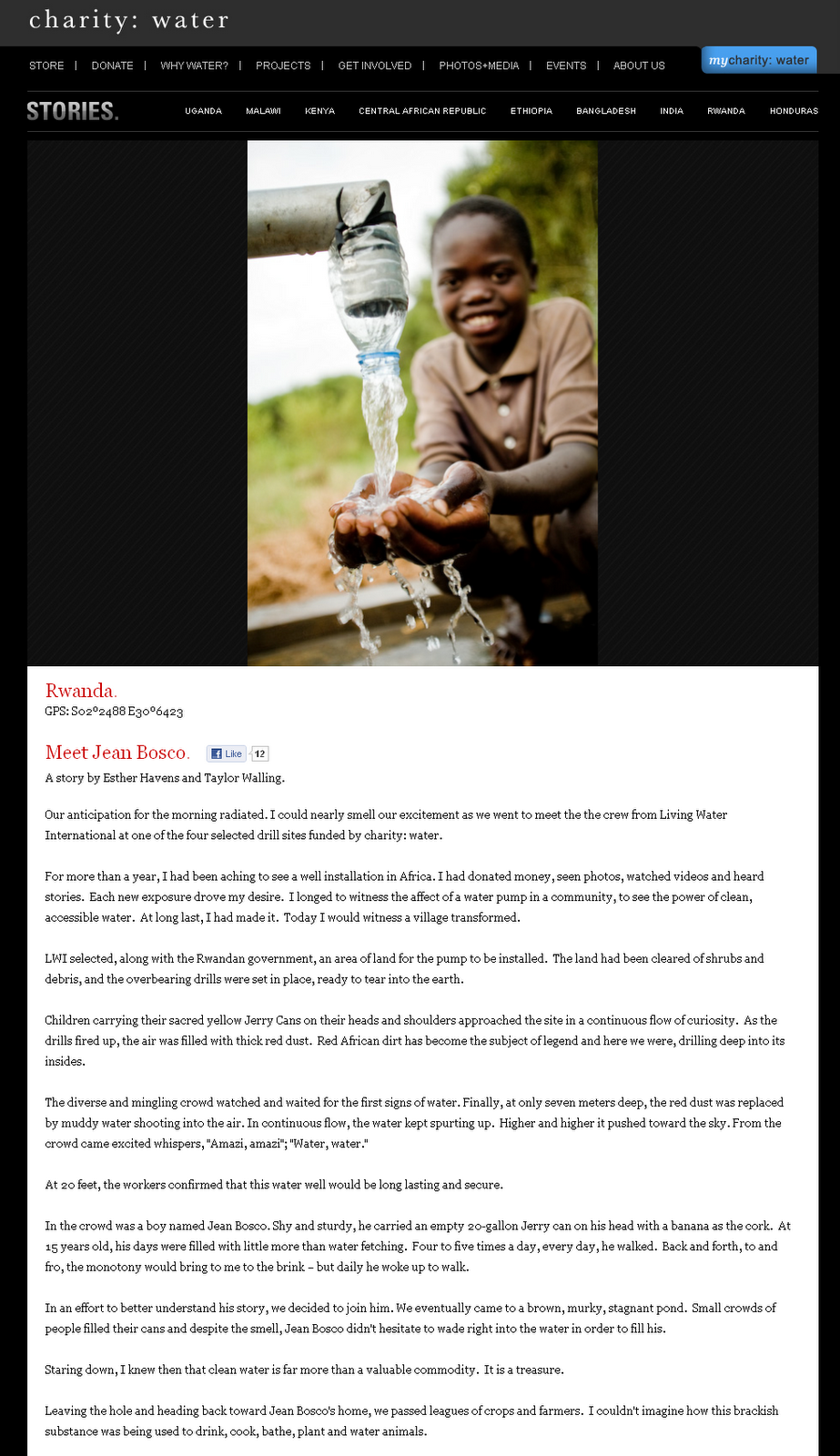
    Illustrate the actual impact your organization is making, including testimonials (if appropriate) and pictures, videos, etc. of the good work you do. This is critical for current donors to see and to make future donors feel like they can make a difference by supporting you with time, talent or financial contributions.

    Example, charity:water: http://www.charitywater.org/projects/fromthefield/index.php


    4) Action page
    Some people - particularly younger generations - are inclined to give their time rather than money. This is a great way to initiate the relationship between your organization and an individual. Is there a petition they should sign? Friends they should invite to join your community? An event to attend? Have a page that gives them an easy way to get involved.

    Example, Red Nose Day: http://www.rednoseday.com/get-involved


    5) Mission / Vision / Goals
    This should go without saying, but you need to clearly illustrate why your organization exists, where you want it to go and what tangible goals you have in your sights.

    Example, To Write Love On Her Arms: http://www.twloha.com/vision/


    6) Social Media page
    First, you should use icons for Facebook, Twitter, YouTube, Flickr, etc. and have them prominently located "above the fold" (visible without scrolling) on your page. Second, you can have a specific landing page with further details on your various social media profiles, campaigns and the people behind your social media efforts.

    Example, WETA: http://www.weta.org/about/contact/socialmedia


    7) Privacy Policy
    In today's world, concern for privacy of data is high - and rightfully so. Therefore, a privacy policy is the helpful and responsible thing to post. As Nagy wrote: "It is important to have a privacy policy for your website even if you do not collect email address from your visitors. Privacy concerns include website analytics, such as google analytics and website cookies. Both analytics and cookies store certain amount of information about your visitors so the concern is real and for you to clear up this concern is a legal obligation to fulfill."

    Example, Cookies for Kids Cancer: http://www.cookiesforkidscancer.org/terms_privacy.asp


    8) Contact Us
    This is a critical and somewhat obvious page, but I have regularly visited non-profit pages that have made contact information challenging to find. Additionally, provide multiple methods for contact. Email and phone are most critical, but it is also good to have various types of contacts - those for giving information/questions, those for the services you provide, any appropriate administrative contacts (HR, etc.). Include your business address and a map or directions, if applicable.

    Example, Polaris Project: http://www.polarisproject.org/content/view/28/109/


    9) About Us
    This should sum up why you exist, what you hope to do and who is running the show.

    Example, Michael J. Fox Foundation: http://www.michaeljfox.org/about.cfm


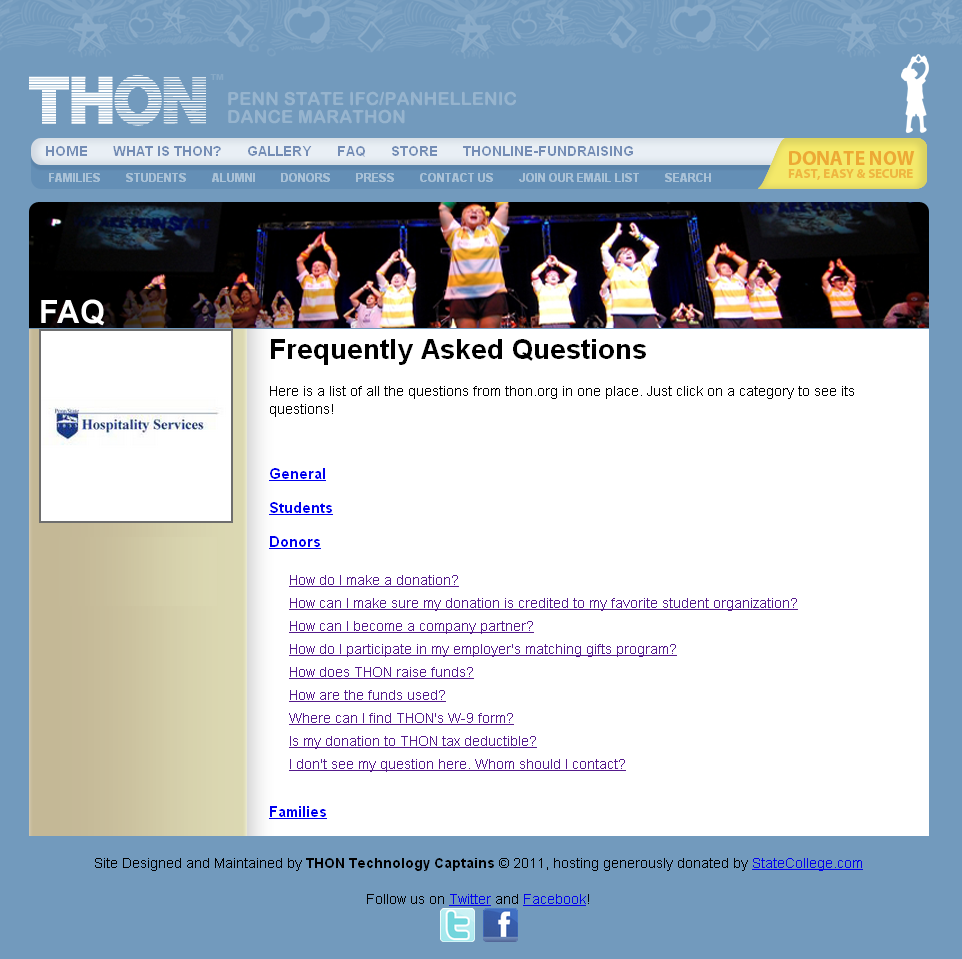
    10) Frequently Asked Questions/FAQ/Q&A
    This is one of the most common pages on any website - for good reason. This can save you time by answering questions for your constituents before they reach out to you and your team.

    Example, Penn State Dance Marathon: http://thon.org/faq


    Bonus #11... optional-ish: Blog.
    I think you should have a blog that can serve as the foundation for engaging donor stories, impact stories and help your social media's content development. Some don't have the time or expertise to maintain a blog... but I think these are just excuses. If you're a non-profit with any gumption, you have connected with content experts (employees, volunteers & friends). Having a blog and scheduling content can help get a misguided communications plan in line. Need help? Let me know. The reason I dub this "optional-ish" is because some non-profits simply aren't prepared to tackle a blog at this point. If you have bigger fish to fry, the blog can wait.

    Example, Kiva: http://www.kiva.org/blog


    Friday, October 1, 2010

    USA Today wants me to what?


    There's benefit to using channels such as Twitter and Facebook to promote content across other channels - sharing a Facebook campaign on Twitter, tweeting about a blog posting, etc.

    But when your goal is engagement, I suggest you don't follow @USAToday's
    example above. I'm a fan of USA Today and I appreciate the kind things the publication has said about my blog, but the tweet above is an engagement failure.

    Suppose you are reading that tweet... USA Today is asking you to leave Twitter, send an email, so you can participate in a Facebook chat. Huh? Could I have a few more hoops to jump through please? ;) I don't mind the promotion of the Facebook chat, but why not ask for questions directly on Twitter?

    I would suggest something like:

    #NCAA football fans: Tweet your questions for a Facebook chat Monday at 12 p.m ET. Use the #ncaachat hashtag so @Erick_Smith can respond!

    USA Today does a decent job promoting this on Facebook, as you would expect.


    I hope this is a good reminder for all non-profits to make it as easy as possible for people to engage with your organization.

    Friday, September 17, 2010

    12 Rules for New Non-Profit Administrators


    Dr. Michael J. Bugeja (@Michael_Bugeja), director of the Greenlee School of Journalism and Communication at Iowa State University, recently contributed an article to the Chronicle of Higher Education entitled 12 Rules for New Administrators, aimed at faculty chairs.

    Though there are many differences between running an academic department and a non-profit, there are also many similarities. Given the parallels, I bring you his list, Through Non-Profit Eyes. There are two items on the list (#'s 2 & 12) that do not translate well to non-profits, so I have added #'s 13 & 14 to ensure you get a full dozen! Enjoy...

    1.
    Start serving others. While reaching this role may be the culmination of a career or an exciting promotion of which you are rightfully proud, you must remember that your job is to serve the organization and its constituents. It is not for you to make yourself look good or gain power.

    Connect with those benefiting from your organization. Praise employee accomplishments in e-mails, newsletters, and meetings. Host brunches and awards banquets, as applicable. Greet everyone when you arrive in the office, and thank everyone when you leave.

    2.
    Stop loving students.

    3.
    Get organized. No matter how passionate you are about your organization, if you are confused in thought, word, or deed, you will create problems for yourself and fail in fundamental tasks. Organization is critical for you to meet all of your objectives and to serve as a good example for your employees, volunteers & donors.

    Stay on track by updating a calendar that reminds you of deadlines and tasks on a daily, weekly, monthly, and quarterly basis. Create a timeline of recurring activities and events, from scheduling annual reviews and honoring deadlines for promotions to event planning and sending solicitations.

    4.
    Appoint a leadership team. This will vary based on the size of your organization and staff. Ideally, you will appoint a leadership team that represents the operations (budget, facilities, HR etc.), fundraising, marketing and the service component of your organization. Review current and upcoming tasks and donor relationships with the team. This will allow the various key members of your team to weigh in with thoughts, opinions and differing perspectives.

    5.
    Be transparent. Transparency is one of the most desired traits in today's non-profit. If a potential donor does not believe an organization is being transparent, he/she is much less likely to support the NPO. When writing memos, keep in mind that anyone may read it. This will help you write more concisely and factually. Keep such memos in a public place - even online. This you will send the message that you've got nothing to hide.

    When you can, pass along messages from key stakeholders and board members. Let your staff know that you will share as much as you can with them, without violating confidences.

    6. Learn how to run a meeting. There are many non-profit employees who complain about the time wasted in meetings. Some important rules that you should set for staff meetings:
    • Call for agenda items one week in advance
    • Keep and approve minutes (post online)
    • Ask people to inform you about announcements or achievements and send them out as an e-mail or PDF rather than waste time reading them aloud at meetings.
    • Set a standing meeting time that does not conflict with others' schedules.
    • Limit meetings to once a month, and keep them under 90 minutes.
    7. Create an advisory committee. This is similar to your leadership team, but can include non-payroll stakeholders who help you fine-tune projects and objectives. The advisory committee should be used for advice, whereas the leadership team can be used to make decisions.

    8.
    Honor governance policies. Seek out any internal policies or guidelines under which your organization has operated. Gain an understanding and appreciation for these policies, but do not let them box you into a corner. If any of these guidelines are preventing your organization from reaching its potential, review your concerns with the leadership team & advisory committee.

    9.
    Resist the natural tendency to play favorites. Little explanation is needed - this can divide a team and create undo angst on your staff. That being said, you need to be self-aware enough to ensure you are treating the team fairly.

    10.
    Become an advocate for civility and diversity. (Unchanged from Bugeja's piece:) Inclusivity should be at the top of your administrative agenda. Devise a diversity plan with professors if your department lacks one and refer to it in routine e-mails or meetings, when occasion allows. Insist on collegiality in employee reviews. Act immediately to deal with stereotyping, harassment, and incivility in others. Especially important is the nurturing of a climate welcoming to women and members of underrepresented groups. Respect for differing viewpoints is essential in any learning environment, and yours should celebrate that as a benchmark for success.

    11.
    Make sure faculty members have mentors. I could not agree with this more. If you replace "faculty" with "staff," you have a critical tool for improving your organization. This is particularly essential with your fundraising staff, where having a mentor for working with potential donors can be invaluable. You will also find great personal reward as those you have "grown" on your team move on to executive roles.

    12. Relearn the promotion-and-tenure process.

    "Replacement rules" for those I crossed off:

    13.
    Know your budget. While having a budget officer is a wonderful luxury, it is important that you know and own your organization's budget. This will provide you with a much better understanding of the impact of all strategic decisions. It will also make you more comfortable saying "yes" and "no" to ideas.

    14. Know your mission. A few years ago, I was giving a presentation to a large number of non-profit administrators. I posed the question to the group "Without using any other resources, can you recite your organization's mission?" Fewer than 10% could. To which I followed up: "If we don't know what our mission is, how can we make a passionate appeal for support and how do we know we're heading in the right direction?"

    Knowing your mission may only illustrate that you are good at memorizing phrases... but owning it and being passionate about what your NPO does will be evident in your demeanor and actions.

    -------------------------------------

    I hope you find these tips useful... Are there any others you would add? Share them below in the comments section!

    Friday, September 10, 2010

    10 Elevator Pitch Tips for Non-Profits


    When speaking to nonprofit leaders, one of the first things I ask them to share with me is their elevator pitch - the quick description of your cause that will motivate a listener to ask for more information, invest in your efforts and/or encourage others to engage with your organization. This provides me with:

    a)
    How: How focused leadership is on the organization's mission?
    b)
    What: What is the organization focused on and trying to do?
    c)
    Why: Why should someone support this organization (the case for support.)

    Granted, if there is a lack of clarity on a), it is likely b) & c) are murky. The same can be said for c) if b) is unclear. More importantly, if your leadership can't speak about why to invest in your organization, why would anyone on the team be able to do so? ...And why should a donor invest in you?

    Along these lines, Paul Hudnut recently blogged about Chip & Dan Heath's newsletter article on six great tips for elevator pitches. Hudnut also provided four additional tips to equal ten tips for elevator pitches.

    Given how important this can be for non-profits, I provide you with the Heath & Hudnut list,
    Through Non-Profit Eyes. I believe it is important for everyone in your non-profit to have a sense for the elevator pitch, even if they are "backroom" staff who many rarely or never engage with constituents. There is a sense of focus and importance that comes with an employee fine-tuning the elevator pitch.

    1. Think short - no shorter than 30 seconds and no longer than 3 minutes. Time it. Practice it. Get feedback from your invested donors and board members.

    2. If your topic is complex,
    use the "anchor & twist" format to orient your audience. Anchor on your organization's impact - we help people lift themselves up, we help students graduate from college and make an impact in the community, we prevent childhood obesity, etc. - and twist to the investment that will make the end result happen.

    3.
    Don't wing it, script it. Once you've figured out how to explain something well, there is NO value in novelty. Tell it the same (effective) way every time. (* I must add that while you should script it, it does not mean you can't improve your script over time via input, etc.) Videotape yourself and critique how engaging you are. As the old Head & Shoulders campaign reminded us: you don't get a second chance to make a first impression.

    4.
    'Why' comes before 'What.' People will understand better what you're doing if they first know why you're doing it. Here's an example: "Most people invest some of their savings and give some of it away to charity. Wouldn't it be nice if you could do both at once -- get interest AND impact? That's why we invented the Calvert Community Investment Notes."

    5. Mandatory:
    Include a story. For a nonprofit pitch, talk about the people or cause you help. Put a true face to the aide.

    6.
    Check out other pitches for inspiration. Here's one that the Heath brothers worked on for Peter Singer's great book, The Life You Can Save:


    7. Know what you want and
    include an ask. This does not have to be a request for a financial contribution - it can be an ask for volunteer work, ideas or even just more time to discuss your organization. Invite them to be engaged with your efforts.

    8. Tell "who." Illustrate why you and your team are the right people to implement your efforts and why you will be successful. People like winners. Illustrate why you and your co-workers are winners.

    9.
    Use questions as well as statements. This shifts your audience from questioning and challenging your idea to wanting to assist you.

    10.
    Delivery matters. In the restaurant business, it is a common training tip for wait staff to say something like "Your customer should never know if you're having a bad day." The same goes for your elevator pitch - have passion, clarity and focus. Make it clear you are not just an employee of the non-profit, but a believer, ambassador and active participant.
    Think through all the non-verbal aspects of your pitch. Videotape yourself. Seriously. You get one chance to make your best impression.

    Your goals:
    a) Make your audience curious - you want them to leave wondering what they could do for you and what more they could learn about your cause.
    b) Get your audience to discuss your pitch with others.
    c) Have an opportunity to revisit the audience members to firm up investment of time, talent and money.

    Share your thoughts, elevator pitch and other input below in the comments section!

    Wednesday, August 25, 2010

    7 Ways To Prove Your Non-Profit Rules


    Jonathan Fields recently
    blogged about a marketing checklist entitled "7 Ways To Prove You Rule." Since proving you rule is cool and fundraising is more parts marketing than anything else, I bring you the post Through Non-Profit Eyes:

    An edited version of Fields' opening:

    The moment you want someone to buy something from you support your non-profit, you take on a Herculean burden…

    The burden of proof. You need to prove to a potential customer, client, patient, reader or visitor donor that the solution you’re offering will solve their problem better, faster, easier, more-effectively or less-expensively than others have an impact on him/her and the values that matter to him/her.

    You can answer every other question, grab attention, build rapport, establish thought leadership, disqualify others, differentiate your offering, share benefit after benefit, claim superiority, reverse risk, create scarcity, incentivize immediate buying and call people to act.
    But if you stumble on the issue of proof…you still lose the
    sale potential donor.

    Because folks need a rational hat upon which to justify an emotional buy investment.

    So, here are the 7 ways you can offer up the proof needed to close the loop on nearly any sale solicitation:

    1. Actual Proof / Track Record

    Point to examples, case-studies, research or other data that demonstrates objectively that your non-profit has a history of fulfilling its mission. People want to know that the investment they make in your organization will be well used and make an impact. They also like to support winners (There's a reason the Yankees, Lakers and Cowboys have historically had more fans than the Indians, Clippers and Lions, respectively). The "woe is me" pitch just isn't appealing - show why you'll be a success with the donor's support.

    2. Pedigree

    Illustrate that the people on your team are worth supporting. Show the expertise of your team in a manner that demonstrates you know what you’re doing and your services or solutions rock.

    3. Authority Endorsement

    Find a leading authority in your industry, not in your organization, who is willing to publicly endorse you - or have an individual who has been a beneficiary of your organization's work give an "impact endorsement." This allows their authority to be your benefit.

    4. Celebrity Endorsement

    First, there can be pitfalls to a celebrity endorsement - if the celeb is caught in a scandal or says something ridiculous... it may unfortunately get attached to your organization. That being said, if potential donors believe that "Celebrity A loves your organization and they’re living the life I dream of, it must be an amazing NPO maybe I should support it too.” Is this logical? Not so much, but for many, it’s reality.

    5. Social Proof

    One of the first things people do when they are on the fence about investing in a cause is look to see what decisions other similar people have made in a similar circumstance. The decisions of those around you, whether good or bad, can hold huge sway over your decisions. So, as a marketer, if you can demonstrate that other people support your NPO regularly and are thrilled with that choice, you’ve just satisfied a serious chunk of your burden of proof.

    6. Theoretical /Logical Proof – “It makes sense that…”

    From Fields' original post: "When you’re lacking any of the above, but you’ve got a product, service or solution that, as lawyers say, 'res ipsa loquitor' or 'the thing speaks for itself,' sometimes all you need to do is make the case." That can be true with NPOs as well. If you have a compelling case, making that case may be enough. If you do not have a compelling case... we should talk.

    7. Metaphorical Proof

    From Fields: "This approach to providing proof is one of the most under the radar, yet potentially powerful approaches. Here, you create an anecdote in the style of a metaphor where a person in a story endures a struggle or experiences a need or pain very similar to what your typical prospective buyer would experience. You set-up the problem and demonstrate the pain, then show how that person resolved their pain and solved their problem using your product, service or solution.
    If you get the first part right, the reader will subconsciously transfer themselves into the story, assuming the role of the protagonist, and like the subject of your story, come to view your product or service as the ultimate solution to their problem. Doing this artfully is not an easy task, but done well, it’s extraordinarily powerful. And, of course, the story you’re telling should be based on a genuine experience of an individual or a composite of people who’ve benefited from your solution."

    For a non-profit organization, this is a powerful tool. You can follow Fields suggestion and illustrate how another investor benefited from supporting your efforts. Or... Rather than putting your potential donor into the shoes of another donor, you can put them in the shoes of your beneficiaries.

    Any examples of how these tools have worked for you?